
SEO Case Study: How SEO Blog Writing Helped a Freelance Medical Writer Get Found and Recognized as a Trusted Voice
This case study shows how I helped an established freelance medical writer turn her blog into a steady discovery channel, resulting in over 228,000 impressions and 2,000+ organic clicks, plus high-quality enquiries from ideal clients.
By focusing on structure, clarity, and consistency (without changing her voice), we built a blog that readers valued and search engines trusted.
This case is a practical example of how SEO blog writing supports visibility, trust, and real business outcomes in health and medical spaces.
The starting point: strong expertise, low discoverability
When we started working together in July 2024, Rachel was already an established freelance medical writer.
She knew her niche well and had real experience to share. Her blog grew out of her day-to-day work with clients. Each post aimed to help and guide the people she wanted to reach. The tone felt natural, and her expertise showed.
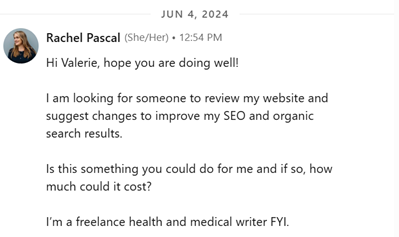
Rachel reached out to me in June after noticing something felt off. Her content was strong, yet it was not getting the visibility she expected in search. She wanted a clear SEO review of her website and practical advice on how to improve organic results.
As she put it:
“I am looking for someone to review my website and suggest changes to improve my SEO and organic search results.”
Like many freelancers and solo entrepreneurs, she was balancing client deadlines alongside blogging. When work picked up, writing for her own site became harder to keep up with.
The writing itself was already in a good place. What the site needed was a clearer structure and a steadier rhythm, so search engines could surface the content more often and the right readers could find it more easily.

Mission Objective: turning a blog into a discovery channel
➤ Support an established freelance medical writer in making her existing blog easier to find through organic search.
➤ The focus was on improving structure, clarity, and consistency, so search engines could better understand the content and surface it to the right readers over time.
The Results: Organic Discovery That Led to Real Enquiries
Over time, Rachel’s blog became a steady source of organic discovery.
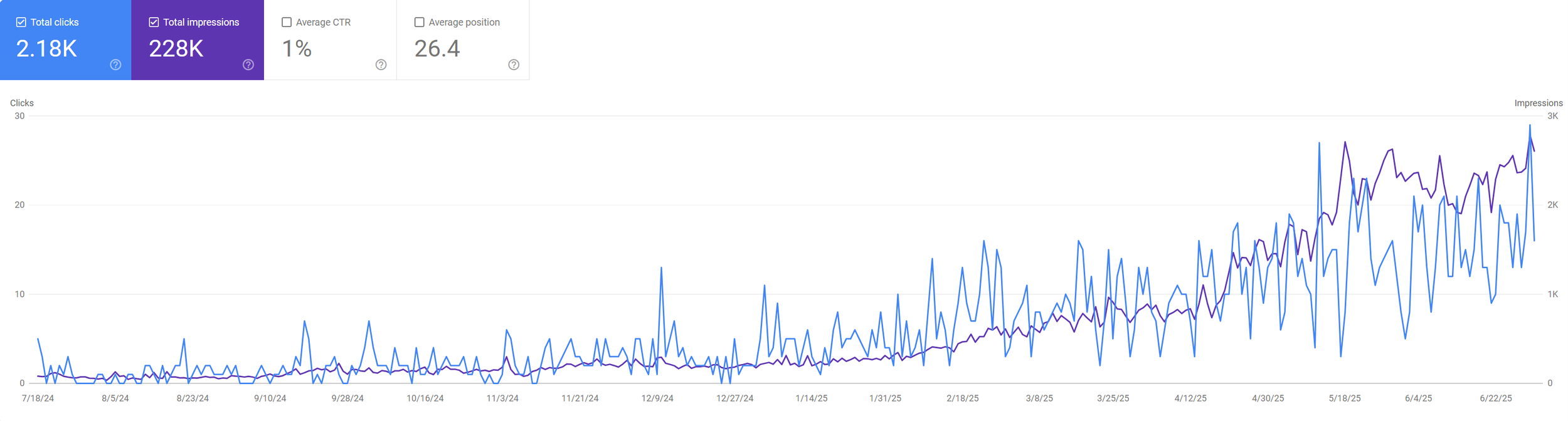
Google Search Console showing steady steady increase in organic impressions and clicks for Rachel’s website, reaching 2.18K clicks and 228K impressions. (July 2024–June 2025)
According to Google Search Console, the site generated over 228,000 impressions and more than 2,000 organic clicks across the period we worked together. This growth followed a clear upward trend rather than short spikes, which reflected steady progress rather than one-off wins.
As the structure of the site improved, more pages began appearing for relevant search queries. New readers discovered the blog directly through Google, often landing on educational posts and spending time exploring related content.
That visibility translated into real business signals. In January 2026, Rachel shared this message with me:
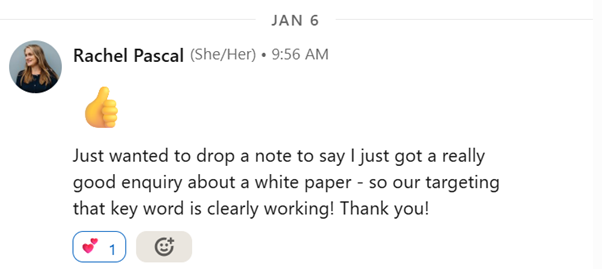
“I just got a really good enquiry about a white paper, so our targeting is clearly working! Thank you!”
Peer feedback supported the same pattern. Several readers commented that they found her articles through Google search and described the content as clear, comprehensive, and genuinely helpful.
Comments from fellow freelance writers on LinkedIn
“This was such a helpful read”
“Loved collaborating with you on this, you’ve put together a great resource!”
“I recently found this via a Google search, and it was very comprehensive and helpful.”
These responses came from other writers and healthcare professionals, which reinforced that the right audience was reaching the site.
Over time, the blog also began appearing as a reference point in AI-generated search experiences. Some articles were cited in Google AI Overviews, which suggested growing trust in the content and its structure.
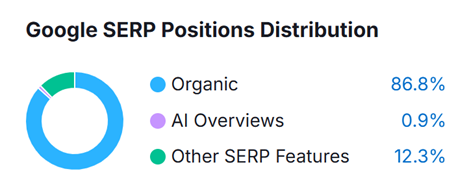
Source: Semrush, domain overview, January 2026.
According to SERP distribution data, most visibility came from organic search, which showed that the blog was performing well in traditional results. A smaller but meaningful share came from AI Overviews, alongside other enhanced search features such as rich results.
While AI Overviews made up a small part of total visibility, these placements showed that Google saw the content as clear, well-organized, and trustworthy enough to use in AI-generated answers.
At this stage, the blog acted as a reliable discovery channel that brought in new readers, professional enquiries, and ongoing visibility without relying on constant promotion.
The Process: What I Did to Get There
Phase 1: Optimize Existing Content (July to September 2024)
I started by working with the content Rachel had already published.
This included a full review of existing blog posts to understand what was working and where search clarity could be improved. I refined structure, improved readability, and clarified the topical focus so each post communicated its purpose more clearly. I also strengthened internal linking, which helped related posts support each other and created a clearer content structure across the site.
This phase led to early traction using existing content alone, without publishing new blog posts.
Phase 2: Consistent SEO Execution (October 2024 onward)
From October 2024, we introduced a steady SEO content creation rhythm that fit around Rachel’s client work.
We worked together on her blog: I drafted two SEO-focused blog posts per month based on her insights to reduce her workload, and to keep publishing consistently. When her schedule allowed, Rachel also published additional posts herself.
The blog benefited from steady SEO execution, and Rachel continued sharing her insights in her own voice.
After about a year, we reduced my cadence to one SEO blog post per month. Rankings and overall visibility remained stable, which reflected the strength of the SEO groundwork already in place.
Why This Worked
This approach worked because I understand health writing, and we’re both small business owners.
We balance client work, planning, and growth every week. That shared experience shaped how the SEO work was planned and carried out, with real schedules and real limits in mind.
I also work as a freelance health writer, so I know how quickly blogging can fall behind when client deadlines stack up. The goal was steady progress that felt manageable, not another task competing for attention.
The strategy focused on clarity and search intent. Each piece of content was organized so search engines could understand it easily, while still reflecting real experience and expertise (EEAT trust signals). Over time, this helped build trust and improve visibility across search results, including newer formats.
Consistency played an important role too. We followed a pace that felt sustainable. That allowed the blog to grow without adding stress or burnout.
Rachel summed it up simply:
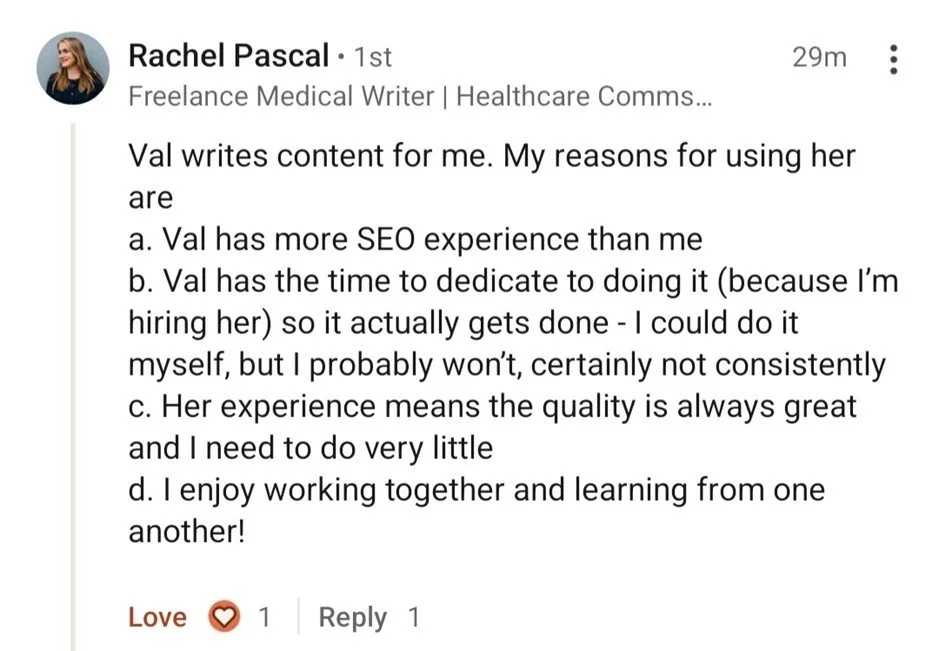
“Val has more SEO experience than me. Her experience means the quality is always great, and I need to do very little.”
As the blog’s visibility improved, something else happened naturally. Trust deepened.
After seeing how the SEO work performed on her own site, Rachel chose to join my SEO health writing mentorship in 2025. Her goal was simple. She wanted to refresh her SEO knowledge and improve the quality of SEO work she delivers to her own clients.
Working together on her website gave her a clear view of how structure, intent, and consistency can improve content performance over time.
Rachel also shared how this experience supported her writing process more broadly:
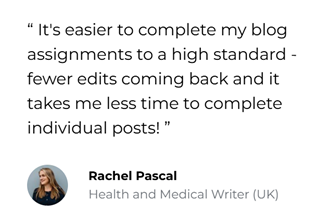
“It’s easier to complete my blog assignments to a high standard. I get fewer edits back, and it takes me less time to complete individual posts.”
That decision reflected the trust built through hands-on collaboration. It showed confidence in my approach and in the way SEO can support quality writing, rather than compete with it.
For me, this is one of the strongest signals of success. A client chooses to learn from the process because it works in real conditions.
Lessons From This Project
This case study highlights a few important points.
Blogs in health and medical spaces can attract steady organic visibility when they are well structured and easy to understand.
Personal brand websites can build authority over time through consistent SEO work, even without large teams or frequent publishing.
EEAT-driven content built around experience, clarity, and trust tends to appear more often in newer search experiences, including AI-powered results.
SEO works best when it supports the client’s voice and expertise
Taken together, these outcomes show how SEO can strengthen good writing and help the right readers find it more easily over time.
If you are part of a health business, medical communications team, SEO agency, or content marketer, or if you work independently as a freelance writer, and you want:
Blog content built with SEO in mind, so it keeps working over time to attract clients
More visibility without having to manage every detail
Support from someone who understands health topics, compliance, and search
There are a few ways we can work together.
I offer SEO health blog writing services, mentoring, and practical workshops or webinar sessions for teams and individuals who want to build stronger SEO foundations.
👉 Get in touch to talk through what would fit your situation best.
Val ✍🏼
FAQ: Doing SEO to Get Clients as a Freelance Medical Writer
-
Not necessarily. Consistency helps, but quality and structure matter more than frequency. Even with a few well-optimized posts, your site can grow visibility if the content is clear, helpful, and aligned with what your audience is searching for.
-
Absolutely, a skilled SEO ghostwriter supports your voice and insights. In this case study, the freelance writer’s tone stayed intact while structure and clarity improved, leading to better results without losing authenticity.
-
EEAT stands for Experience, Expertise, Authoritativeness, and Trust. Google’s raters use these signals to evaluate the quality of health-related content. As a medical writer, showing lived experience, credentials, and transparency helps your content perform better in search and builds trust with readers.
-
Results vary, but in this case study, meaningful progress happened within 3–6 months, with sustained growth over the year. SEO is a long game: consistency and structure pay off over time, especially in competitive niches like health.
Share this article:








About the Author
Valérie Leroux, MSc, is a bilingual SEO health writer and founder of Bioty Healthcare since 2022, helping health brands and medical writers create high-ranking, trustworthy content backed by science and empathy.

Compare the best medical writing courses by career goal (freelancing, SEO, pharma, patient education, CME, or academia) with real-world guidance and honest insights.