
You need your content to rank in search, build trust, and help real people, while also staying accurate, ethical, and compliant. Finding that balance is not always easy.
For many years, the goal of health blogs was clear: explain the facts well and support them with evidence. This style still works for topics where people are looking for clear, factual answers. It reflects Google’s long-standing focus on Expertise, Authoritativeness, and Trustworthiness (E-A-T) in health content.
In December 2022, Google added Experience to this framework, turning it into E-E-A-T. This update reflects how people search today. Many readers want to know what a condition is like in real life, which they cannot get from textbooks. I can see this in search results increasingly showing forums like Reddit next to clinical pages.
This creates a real question for many teams: When does personal experience help a health blog, and when does it create risk?
I’ll show you how to tell when personal health stories support SEO and EEAT, how to spot this in search results, and how to use lived experience in a way that stays accurate, respectful, and safe.
By the end of this article, you’ll know when to include personal health stories, when to leave them out, and how to use them responsibly if you work for a clinic, a nonprofit, or a health brand.
TL;DR: Using personal health stories in SEO content
Personal health stories belong in SEO blogs when lived experience matches what people are searching for. Forums and first-person content in search results are strong signs of this. For technical or academic topics, stories often add risk without improving relevance.
Personal health stories can strengthen SEO and EEAT, but only when they clearly match human search intent
Stories work best for emotional, lived-experience queries
Both patient stories and HCP experience can count as “Experience” when framed correctly
Stories build trust when they support evidence. They’re not supposed to replace it.
Consent, clinical alignment, and restraint matter more than storytelling flair
If a story doesn’t improve clarity, empathy, or usefulness, leave it out
The key is to use the story in service of the reader’s question. In my guide to SEO storytelling for health businesses, I explain how to use stories on blogs, service pages, and website copy in a way that feels human, ethical, and still clear for search.
What counts as a ‘personal health story’ in SEO content?

In cancer content, personal health stories often capture quiet, everyday moments. These moments help readers understand the lived experience beyond medical facts.
Source: Photo by Ivan S from Pexels.
When people hear “personal health story” or “personal experience”, they often assume it means a patient writing in the first person: “This is what happened to me.” That can be a personal story, but in SEO health content, it’s far from the only option.
From my experience as a health writer and editor, a personal health story is any content that’s grounded in real-world human experience. In other words, it helps the reader understand what a condition, symptom, or treatment is actually like in real life.
That experience can come from patients, caregivers, or healthcare professionals, as long as it genuinely serves the reader.
The main types of personal health stories I use in health blogs
Here are the formats I most commonly work with when writing SEO health content for brands and clinics:
1. First-person patient (or caregiver)stories
These are written using “I” and describe someone’s lived experience directly: symptoms, diagnosis, treatment, side effects, emotions, and daily life.
They work well when people are searching things like:
“What is it really like to live with…?”
“How does this condition affect everyday life?”
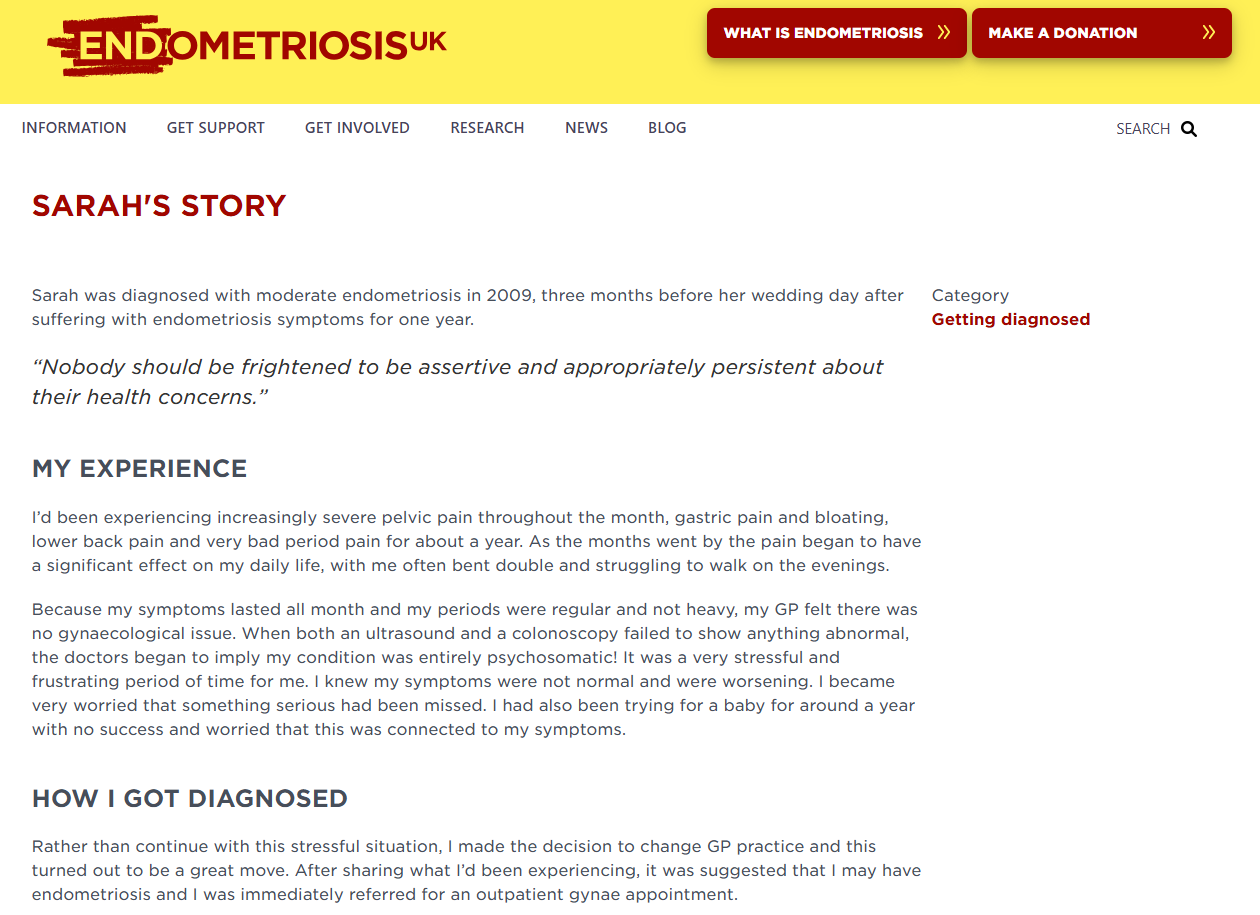
Example of a first-person patient story from Endometriosis UK, showing a woman describing her experience of symptoms and diagnosis in her own words.
They can be very powerful, but they need careful handling:
Clear consent
Clear boundaries
Not presented as medical advice
2. Third-person patient (or caregiver) stories
This is often the most practical option for health brands. The story is still real, but it’s told through an interview or reported narrative rather than “I”. It allows you to keep a professional tone while still being human and relatable.
A good example is Ed’s kidney cancer story used in pharma content. His journey is told through his own words and his family’s perspective, but with clear framing, disclaimers, and clinical context. It shows what the experience felt like (uncertainty, hope, family support) without over-promising outcomes.
Similarly, Charlotte’s cochlear implant story, which I wrote for MedTech Europe, follows a real patient’s path from early symptoms to diagnosis, surgery, and recovery. What makes it work is that it shows:
The impact a condition can have on self-confidence and mental health
Everyday personal and professional challenges, such as communication with colleagues or loved ones
The emotional impact on family life
That’s the part readers recognize themselves in.
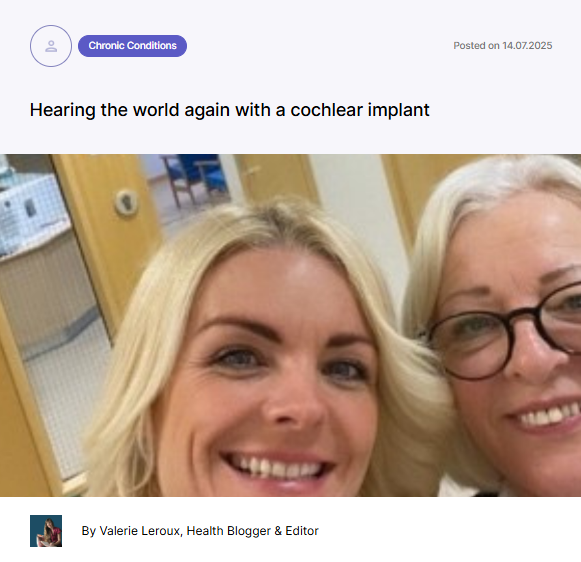
Charlotte’s cochlear implant story - MedTech Europe
3. Healthcare professionals sharing lived clinical experience
This is an important one, and it’s often misunderstood. Healthcare professionals can also share experience, as long as it’s done responsibly. By that I don’t mean sharing individual patient cases. Instead, it’s about reflecting patterns seen repeatedly in real practice, for example:
“Many parents come to us worried about…”
“A common concern we hear in clinic is…”
“We often see this combination of symptoms…”
In this GP clinic example, this line does a lot of heavy lifting:
“Many parents describe the same worries… and often feel confused or dismissed.”
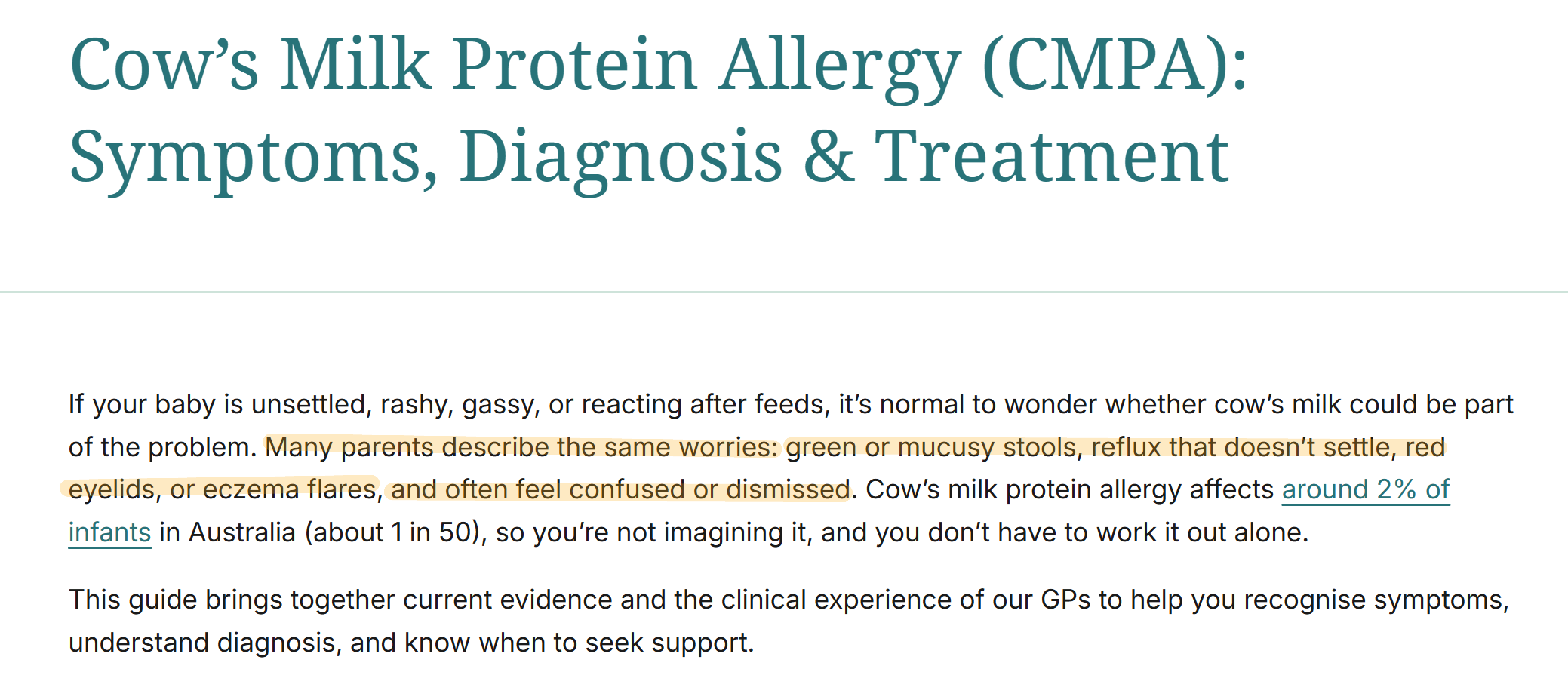
Example of a blog for a GP clinic. I’ve highlighted the reported personal experience in orange. This sentence contributes to establishing the GP’s credibility and helps connect with the audience by using the words they use.
This example shows how the words people use in Australia were used to describe symptoms as reported to their GPs, which gives us a chance to rank for those keywords, as well as build the GPs’ credibility. Typically, this is also a good way to go beyond what AI Overviews and other articles can provide (purely a generic list of symptoms, which is covered later in this blog post to be more comprehensive).
That single sentence tells the reader:
We see this all the time
You’re not imagining it
You’re not alone
From an SEO and trust perspective, this works extremely well because it:
Signals real-world experience
Validates patient emotions
Stays aligned with evidence
Avoids consent and privacy issues
For clinics especially, this aggregated clinical experience is often the safest and most effective way to bring the “Experience” part of EEAT into health blogs. This kind of experience-led framing is especially effective for clinic blogs, and it’s something I apply consistently when writing SEO health content for healthcare organizations.
And it works! This experience-led approach helped the page rank above large brands and professional groups. Google also used it as a trusted source in AI Overviews, alongside national organizations :
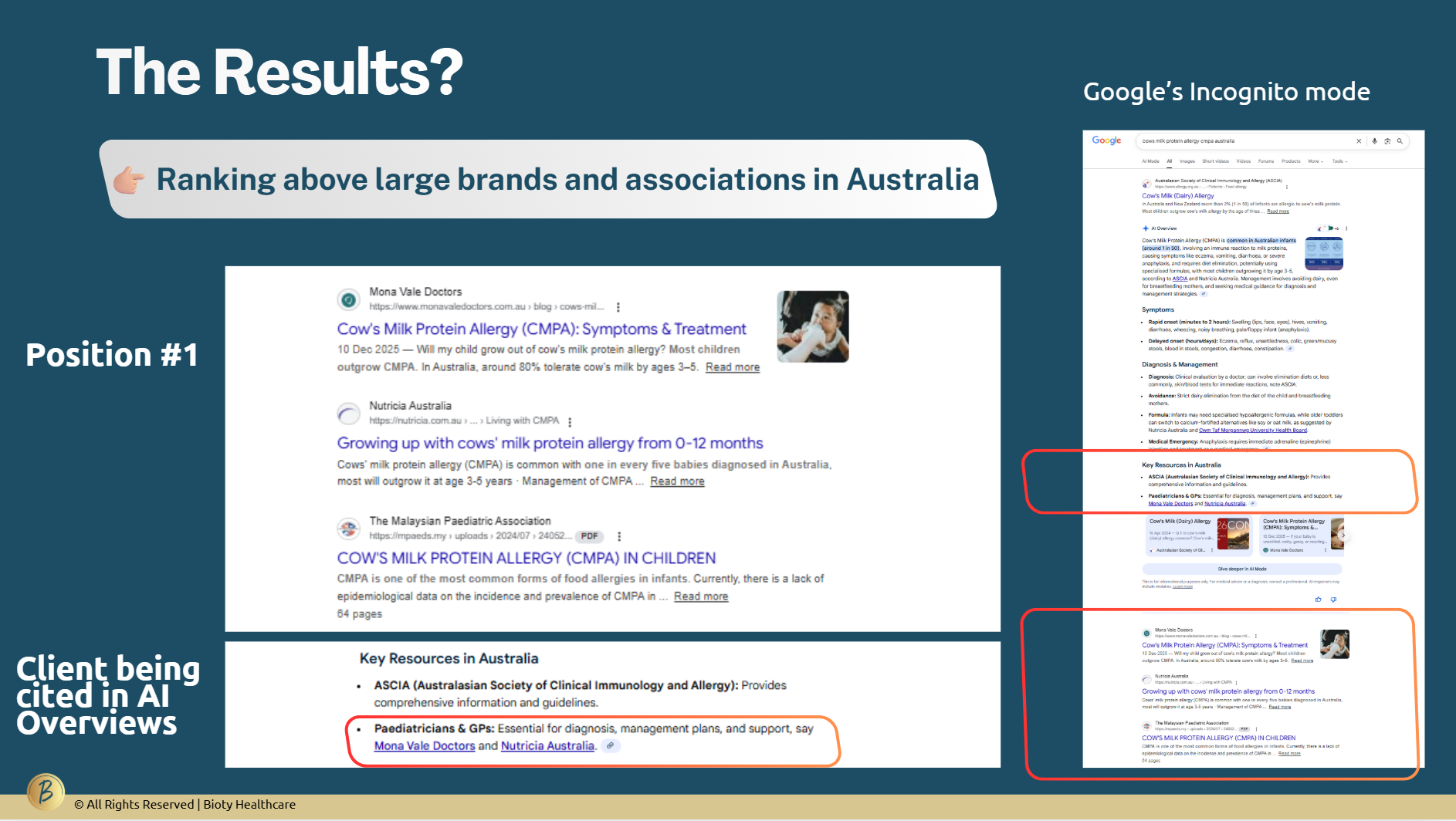
Example of results for a client, a GP clinic blog page ranking highly and cited in AI Overviews (with a link!) after using aggregated clinical experience.
Source: This slide comes from my E-E-A-T webinar, Building Trust & Authority with SEO Health Blogs. In this hands-on session, I show real examples of how trust signals and lived clinical experience can improve visibility in search and AI results.
Do personal stories actually influence reader behavior?
You may be wondering: “I get that stories are engaging, but do they actually change what people do?”
From my experience working on SEO health blogs, the answer is often yes, but only when stories are used with intention. And we’re not just relying on gut feeling here. There’s research that backs this up.
What happens after people read patient stories?
A 2021 study looked specifically at what happens after people read patient health blogs [1].
One finding I often come back to when explaining this to clients is this:
More than half of readers (53%) reported taking some form of preventative health action after reading a patient blog [1].
These actions were realistic, sensible next steps: exactly the kind of actions health content aims to encourage.
Readers reported [1]:
Booking or planning a GP or specialist appointment
Asking a doctor about their own health risk
Requesting screening tests
Doing self-checks (for example, skin or breast exams)
Making lifestyle changes or looking for more reliable information
What’s particularly interesting (and very relevant for SEO) is that these actions didn’t depend on readers suddenly believing they were at high risk. Simply reading a well-written, experience-based blog was often enough to prompt them to act.
Why this matches what I see in practice
This aligns closely with what I see when I analyze performance and feedback on health blogs. Besides gaining information, people come to blogs because:
Something doesn’t feel right
They’re unsure whether symptoms matter
They want reassurance that they’re not overreacting
When content includes real experience (whether that’s a patient journey or patterns seen by clinicians), it helps readers recognize themselves in the story. That recognition is often what nudges them from reading to doing something about it.
The same study also found that readers consistently described patient blogs as [1]:
Emotional
Well-written
Easy to understand
Informative
That’s important. The most effective content was both emotional and factual.
A practical takeaway for health brands and clinics
Personal stories won’t replace clinical guidance, and they shouldn’t. But when used thoughtfully, they can:
- Reduce hesitation
- Normalize concerns (“others have felt this too”)
- Help readers decide when it’s worth seeking care
For SEO health blogs, this supports better engagement, stronger trust signals, and content that helps people take appropriate next steps.
When does it make sense to include a personal health story in SEO content?
One of the biggest mistakes I see in SEO health content is adding personal stories because they feel nice, not because they match what people are actually searching for.
Before I include any personal or patient story in a blog, I always ask myself one question:
Is lived experience part of the human search intent?
One way to confirm what may be our gut feeling is by looking closely at the search engine results page (SERP), knowing that Google is not always right, and at the end of the day, we should know better our audience.
Examples of SERP clues showing me that experience matters for this topic
Here are the signals I rely on most when deciding whether a personal health story will strengthen a piece of SEO content.
1. Forums like Reddit or Quora appear on page one
When Google surfaces forums, it’s usually a strong signal that people want real answers from real people. These platforms rank when users are searching things like:
“Is this normal?”
“Has anyone else experienced this?”
“What actually helped you?”
If forums are ranking, it often means a purely clinical blog won’t fully satisfy the query on its own. Whether this information should come from real users, experts, or both is for us to find out. For example, forums sometimes reveal that there’s confusion or debate around the topic, and users want to seek answers from perceived experts.
Here is the example of a search for “endometriosis back pain” showing top-ranking results from forums and Facebook groups, and where it makes sense to share personal stories:
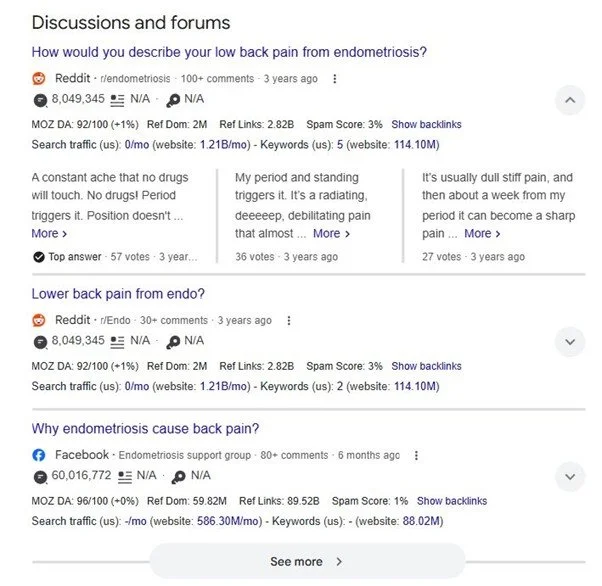
Example of a query returning forums and Facebook groups
2. People are asking “What’s it really like to live with…?”
I pay close attention to the People Also Ask box. Questions such as:
“What’s it really like to live with migraines?”
“How does endometriosis affect daily life?”
“How do people cope with infertility emotionally?”
These are experience-driven questions. They’re asking for context, emotions, and lived reality. That’s where personal stories add real SEO value.

Example of People Also Ask question showing a need for lived experience
3. Top-ranking content uses first-person tone or interviews
If you notice that the pages ranking well:
Use “I” or “we”
Include patient interviews
Feature quotes, videos, or vlogs
Share real journeys or testimonials
That’s a strong editorial cue. Google is already rewarding experience-led formats for that topic, so excluding them may put your content at a disadvantage.
4. The condition has a strong emotional or lifestyle impact
Some health topics almost always benefit from experience-based content because they affect far more than just physical symptoms. In my experience, this is especially true for conditions like:
Cancer (melanoma, multiple myeloma, and leukemia in particular show a lack of personal experiences, while people are searching for them)
Women’s health (Infertility, endometriosis etc.)
Chronic pain
Invisible disabilities like hearing loss
Neurodivergence (such as autism or ADHD) and neurology-related conditions like migraines or dementia
Mental health conditions
Rare diseases
For these topics, people are asking “How do people live with this?” and “Why does no one talk about this part?”
Ignoring that emotional and lifestyle layer can make content feel incomplete, even if it’s medically accurate.
What kind of stories do health readers trust — stats or emotions?
Should we lean into the human story or focus on the data? The right answer is: it depends on the intent, but in many cases, both could be used together on purpose.
What the research actually shows
One of the most interesting findings from the 2021 study published in the Journal of Medical Internet Research was this [1]:
Blogs focused on statistics performed very well
Personal patient stories also performed well
Both clearly outperformed more general, non-specific health blogs
In other words, readers responded to content that either:
Helped them understand how common or relevant a condition is, or
Helped them understand what the experience is like in real life
Why stories and stats do different jobs
This comes down to psychology, and it’s very practical when you’re writing health content.
Stories create relatability.
They help readers recognize themselves in the content and feel less alone.Statistics create credibility and social proof.
They answer questions like:Is this common?
Do clinicians actually see this often?
Is this worth acting on?
Here’s a good example:
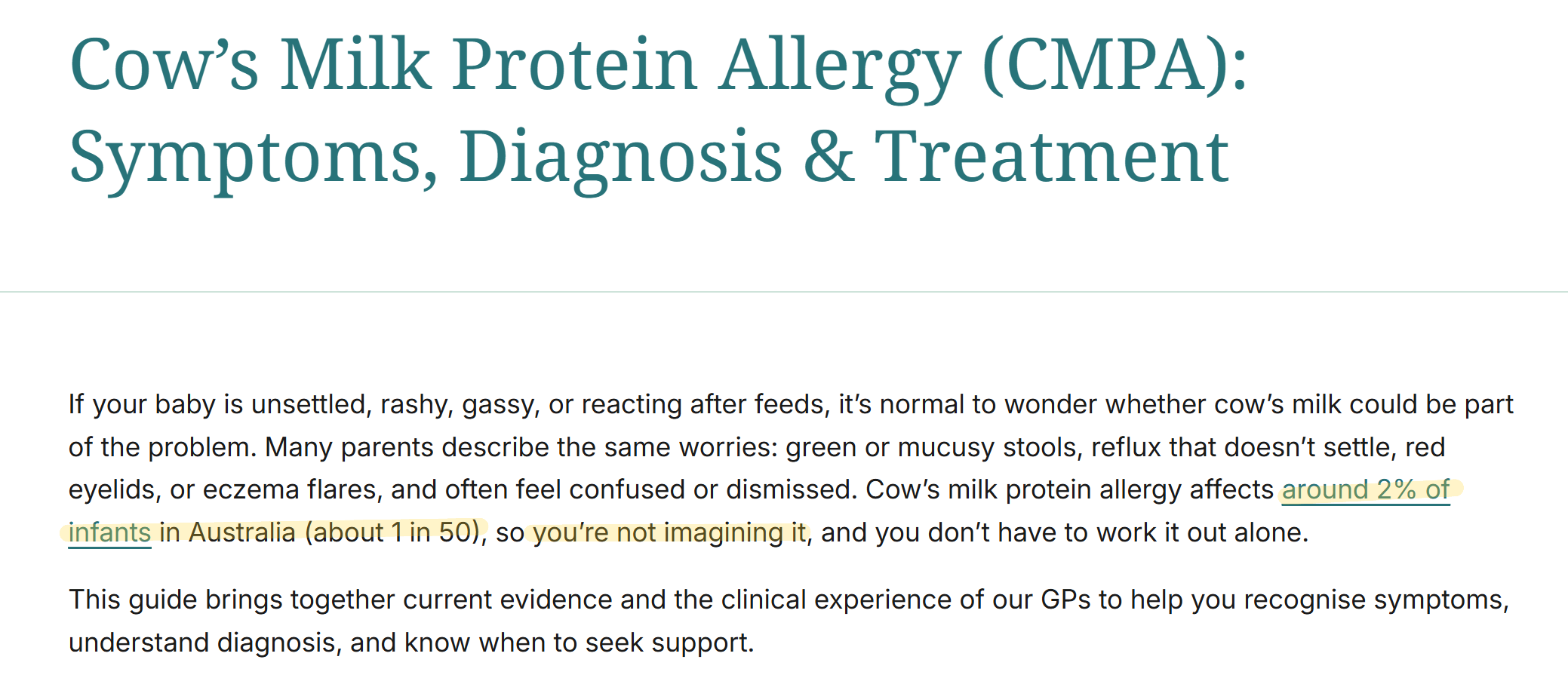
Reported clinical experience highlights how parents often feel dismissed. The statistic that follows helps confirm those concerns and reduce doubt.
Source: https://www.monavaledoctors.com.au/blog/cows-milk-protein-allergy-cmpa
In the JMIR study, statistical blogs were particularly effective at reducing perceived barriers to care [1]. In other words, they made taking action feel more reasonable and achievable.
This article is another example of that balance
Look at this blog post again: it is a good example of how I approach this balance in practice. Although I’m not sharing an emotional patient story here, I am combining:
Data from a peer-reviewed study
My lived experience as an SEO health writer and editor
Practical insights from working on real SEO health blogs - showing you how I apply my own tips to my content (and proof that it works!)
That combination is great to build trust, even if emotional storytelling is not always needed.
How do you include patient stories without risking trust or compliance?
This is usually the point where teams and writers get nervous, and honestly, for good reason. Patient stories can be incredibly powerful, but if they’re handled carelessly, they can also damage trust, create legal risk, or undermine a brand’s credibility. Over the years, this is the framework I’ve learned to rely on to keep stories useful, ethical, and safe :
Get clear consent
If a story is based on a real person, you need explicit permission. This means I used a written consent form before interviewing the patient. If that is not possible, the story should be anonymized or reframed as a general experience rather than a personal narrative. When there is any doubt, I leave identifying details out.
Use third-person storytelling when possible
For most health brands and clinics, third-person stories are the safest option. They keep a professional tone, focus on the experience rather than the individual, and avoid unnecessary personal details. This is why many pharma and medtech patient journeys use structured third-person formats with clear context.
Share only what serves the reader
Not every detail adds value. I always ask:
Does this help answer the reader’s question?
Does it support the search intent?
Would this feel appropriate on a clinic or brand website?
Details that do not serve the reader can reduce trust.
Stay aligned with medical evidence
Stories work best when they add context to evidence, not when they suggest outcomes or advice that go against guidelines.
Use clear disclaimers
Simple phrases like “results may vary” or “always speak to your healthcare provider” help set expectations. They remind readers that one story is not medical advice.
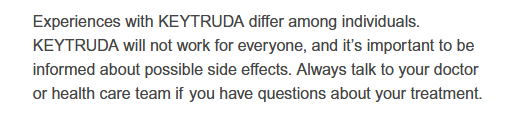
Example of disclaimer used in pharma content
My rule of thumb
If a patient story feels respectful, fits the brand voice, supports evidence-based care, and genuinely helps the reader, it usually strengthens trust rather than putting it at risk.
What are signs you should not include a personal story?
Over time, I’ve learned that knowing when not to use lived experience is just as important for EEAT as knowing when to lean into it. Here are concrete, real-world situations where I’ve deliberately left personal stories out (and why) :
1. When the search intent is clearly asking for science
Real examples: A blog targeting “how does immunotherapy work?” or “mechanism of action of biologics”
Stories would dilute authority unless they’re tightly anchored to expert explanation, and even then, they rarely improve rankings or user satisfaction for this intent.
2. When brand or regulatory guidelines explicitly prohibit anecdotes
Many brands simply cannot publish patient anecdotes outside very specific, approved formats (e.g. testimonial pages with legal review).
3. When there is no clear permission trail
“Composite” stories created from clinical experience or casual patient conversations framed as individual stories instead of general clinical experience can raise red flags, legally and ethically.
4. When the story risks being interpreted as medical advice
I’ve reviewed drafts where a personal experience:
Implied a treatment “worked”
Suggested a workaround to clinical guidance
Reflected an outcome that isn’t typical
Even with disclaimers, readers may still generalize if you’re not careful with the way the story is written. Personal experiences can unintentionally override evidence in the reader’s mind, which is risky in content like health.
Can patient stories help improve EEAT for SEO?
Short answer: yes, when they’re used intentionally and responsibly.
Longer answer: Yes, first-hand experience is a Google-recognized trust signal. Google’s Search Quality Evaluator Guidelines explicitly value first-hand experience when it’s relevant to the topic.
Patient stories can also help avoid “generic AI content” signals
This is a big reason brands are revisiting lived experience right now. AI can summarize studies and explain conditions extremely well, but it can’t genuinely replicate lived experience, interviews, or original patient journeys.
When used properly, patient stories:
Add originality that’s hard to automate
Reduce the risk of “same-as-everyone-else” content
Create differentiation in SERPs filled with near-identical medical explainers
I’m not anti-AI, and the use of AI is not penalized by Google per se, but adding real personal experience when it makes sense for readers is a nice way of making sure you’re being truly helpful and differentiating yourself from the information that can be provided in an AI Overview.
They add value for readers (which is what EEAT ultimately rewards)
Patient stories improve EEAT because they help readers:
Feel understood
Anticipate real-world challenges
Make sense of complex health information
When stories are relevant, respectful, and well-placed, they improve engagement, clarity, and trust: all of which are aligned with how Google defines high-quality content.
How can your team create or source high-quality patient stories?
Here are realistic ways I’ve seen clinics and health brands source patient stories:
1. Interview real patients (with consent)
This is the gold standard, and it doesn’t need to be complicated. In practice, this can look like:
A short, structured interview (written or recorded)
Follow-up questions by email
A story drafted by a writer and approved by the patient
What works best is guidance. Patients need prompts that help them tell their story clearly.
From experience, the strongest stories come from focused interviews with 5-8 questions I prepared in advance, while leaving room for follow-up questions based on the answers. I have also looked at existing podcasts and the information they shared on social media to collect insights and draft a sample for them to review.

Testimonial from Charlotte Young after I drafted her story for MedTech Europe.
2. Use healthcare professional (HCP) experience
Clinicians, nurses, and allied health professionals can safely share:
Common patient concerns they see repeatedly
Patterns in diagnosis journeys
Emotional or practical challenges patients often describe
I’ve used this approach often for clinics where patient testimonials weren’t permitted and it works extremely well for SEO and trust.
3. Curate stories from public or partner sources
Another underused option is ethical curation. This can include:
Public patient stories from partner charities or advocacy groups
Campaign stories with reuse permission
Clearly attributed summaries of public experiences (not copied verbatim)
The key is transparency:
Attribute the source
Explain why the story is relevant
Don’t present it as your own patient unless it truly is
This approach works particularly well for awareness-driven or educational content.
Final thoughts: How to use personal health stories well (in practice)
In day-to-day content work, personal health stories are most effective when they’re treated as a strategic content format instead of a creative add-on. Here’s what that looks like in practice:
Use stories to clarify lived impact which can’t be found in scientific data
Clarify the human search intent to decide if experience belongs
Default to third-person or HCP experience when consent or compliance is complex
Pair stories with evidence so readers leave informed
Remove stories that don’t actively improve understanding, trust, or decision-making
When teams apply this consistently, a few things happen:
Content becomes easier to approve internally
Trust increases without increasing risk
Blogs differentiate naturally in crowded SERPs
EEAT improves as a by-product of usefulness
The strongest health blogs I’ve worked on don’t use stories everywhere. They use them precisely, where experience genuinely adds something evidence alone cannot.
If you’re a clinic, nonprofit, or health brand trying to apply these principles in your own content, this is the framework behind my SEO health blog writing services.
Do you know if your blog has the best chances of being visible and credible?
If you're wondering whether your content meets the highest EEAT standards, I offer practical recommendations for health businesses and organizations to help your website show up on Google and AI to get found by the right people. Submit your contact details below and I’ll be in touch 👇🏼
Val ✍🏼
FAQ: Personal experience and health stories & EEAT in SEO
-
Yes, personal stories can harm trust (and therefore SEO) if they’re not framed correctly.
Patient stories don’t need to be written by clinicians, but they should be:
Clearly positioned as lived experience, not advice
Edited by a health or medical writer
Clinically reviewed when discussing diagnosis or treatment
This protects trust while still supporting E-E-A-T.
-
No, even short patient stories can be effective. For example :
A short embedded paragraph
A single quote addressing a common concern
One practical insight that adds context
If adding to the story doesn’t clearly serve the search intent, length will only dilute impact.
-
Yes, and they’re often the safest option. Healthcare professionals (HCPs) describing:
Common patient concerns
Typical journeys
Repeated misconceptions
still demonstrate first-hand experience without identifying individuals. This approach works well when consent or compliance is complex.
References
Taylor KA, Humphrey WF Jr. Impact of medical blog reading and information presentation on readers’ preventative health intentions: mixed methods, multistudy investigation. J Med Internet Res. 2021;23(12):e23210. doi:10.2196/23210
Related Resource
This blog includes materials presented in Building Trust & Authority with Health Blogs (E-E-A-T). This is a 90-minute, hands-on SEO workshop. It focuses on practical ways to spot and apply trust signals in health content, improve author credibility, and increase visibility in Google and AI systems. The live session includes simple exercises to complete after the workshop, with personal support by email.
Share this article:




About the Author
Valérie Leroux, MSc, is a bilingual SEO health writer and founder of Bioty Healthcare since 2022, helping health brands and medical writers create high-ranking, trustworthy content backed by science and empathy.

See how a health e-commerce brand recovered rankings and scaled with a multilingual SEO strategy, reaching 6.4M impressions and US market growth.