
Best Medical Writing Courses in 2027: My Selection of Top Programs by Career Path
When I was searching for medical writing courses myself, I couldn’t quite find what I was looking for, and to be fair, I had no idea what employers and clients really cared about. I personally invested more than $2,000 in training when I was starting out. Those courses gave me solid foundations, but they were also very generic. They didn’t show me what day-to-day freelance medical writing actually looks like, how to build confidence with real briefs, or how to know whether I was doing “a good job” before working with clients. That gap between learning theory and feeling client-ready is something I now see again and again in writers I mentor.
I remember being in that exact place :
Which course is actually worth the money?
Do I need a certificate to get hired?
How long will this take, and will it really lead to paid work?
Is medical writing even realistic for someone like me?
How many more medical writing trainings do I need to complete before starting to work with clients?
Since 2022, I’ve worked as a freelance SEO health writer and editor, built Bioty Healthcare, and supported clinicians, scientists, translators, and experienced writers as a mentor.
That’s why this guide exists. I didn’t want it to be a directory of every medical writing course available. Instead, I’ve focused on:
well-known programs people actively search for
courses and mentors I know personally, or have heard consistently positive feedback about
training that represents different medical writing career paths
options at different levels of financial commitment
programs that help you understand what the work actually looks like
In this guide, I’ve compared medical writing training options according to what you actually want to do: explore medical writing, transition from healthcare or academia, write SEO health content, create patient education, work in pharma advertising, specialize in CME, build your freelance business, or pursue more formal credentials.
I’ll continue to update and expand this list over time based on feedback from readers like you.
TL;DR: Which Medical Writing Course Should You Choose in 2027?
→ If you’re just exploring the field, you probably don’t need to spend thousands of dollars yet.
→ If you already know the type of medical writing you want to pursue, specialist training, feedback, and practical experience become much more valuable.
Here’s the short version:
I’m only exploring medical writing: Start with Coursera for low-commitment foundations (scientific writing, terminology, health communication). Useful for testing interest, but not enough to become client-ready.
I’m transitioning from healthcare or academia: Write Clinic offers practical, beginner-friendly training tailored to clinicians and scientists, with portfolio guidance and career logistics (use BIOTY10 for a 10% discount).
I want structured professional medical-writing foundations: AMWA education may be an option.
I want to write SEO health content for clients: Bioty’s SEO health writing training ecosystem, including workshops, courses, and a 1:1 mentorship program.
I want to specialize in patient education: Bioty + Kathrin Kunze’s patient education course
I need help with freelancing, pricing, and positioning: Rachel Pascal’s mentoring
I want to work in pharmaceutical advertising: Medical Copywriting Training Program
I want to specialize in CME/CE writing: WriteCME Pro
I need formal credentials or regulatory credibility: The University of Chicago Medical Writing Certificate offers academic rigor and prestige, but expect a higher cost and less real-world freelancing focus.
If you’re not sure which niche to pursue yet (I know I had no clue when I started), the right course could give you a better idea of what this niche looks like in practice before committing to client work. Let’s be clear: there’s no single “best” medical writing course, as most experienced medical writers build their skills gradually. A foundation course may help you understand the field, then specialist training helps you develop the type of writing you actually want to do.
A certificate can be useful, but a certificate alone doesn’t make someone client-ready. Your writing quality, evidence literacy, ability to work with a brief, understanding of the audience, portfolio, and professional skills also matter to become a freelance medical writer.
You don’t feel ready to choose a course yet?
I share monthly SEO and medical writing tips, new training opportunities, and private early-bird discounts with my email subscribers.
Best Medical Writing Courses in 2027 (Compared by Career Goals and Financial Commitment)
I’ve grouped 9 reputable training options by career outcome and financial commitment, so you can choose based on where you want your medical writing career to go and what you’re ready to invest.
| # | Career goal | Best option | Best for | What you gain | Practical experience | Budget level |
|---|---|---|---|---|---|---|
| 1 | Explore medical writing | Coursera | Beginners testing the field | Scientific writing, terminology and communication foundations | Limited | €–€€ |
| 2 | Transition from healthcare or academia | Write Clinic | Clinicians, scientists and PhDs | Medical writing skills + career logistics | Yes (guided samples) | €€ |
| 3 | Build professional medical writing foundations | AMWA | Medical communicators wanting structured professional development | Essential medical writing and communication skills | Varies by training | Varies |
| 4 | Become client-ready in SEO health writing | Bioty SEO Health Writing Training | Health writers, clinicians, journalists and translators | SEO research, search intent, E-E-A-T, strategy and workflow | Yes (real SEO writing exercises) | €–€€€€ |
| 5 | Specialize in patient education | Patient Education Course: Bioty + Kathrin Kunze | Writers and healthcare professionals creating patient-facing content | Plain language, empathy, patient needs and discoverability | Yes (before-and-after exercise) | $97 |
| 6 | Strengthen freelancing and pricing strategy | Rachel Pascal Mentoring | Early-stage freelancers | Rates, pitching, positioning and business strategy | Mentoring-based guidance | €€ |
| 7 | Work in pharma advertising | Medical Copywriting Training Program | Writers targeting pharma and healthcare agencies | Regulated promotional copy + agency workflow | Yes (portfolio-ready promotional sample) | €€€ |
| 8 | Specialize in CME / CE writing | WriteCME Pro | Clinicians, academics and experienced writers | CME compliance, educational design and deliverables | Yes (CME-focused projects) | €€€€ |
| 9 | Gain formal academic credentials | University of Chicago Certificate | Regulatory, editing and publication-focused writers | Editorial rigor + formal university credential | Writing and editing exercises | €€€€€ |
If You Only Want to Touch the Surface of Medical Writing (Lower Commitment but Less Practical): Coursera
Coursera works best as an orientation tool. It’s a helpful way to confirm whether health or scientific writing is something you genuinely enjoy, but is not sufficient on its own. The platform hosts a large catalogue of university-led courses that help you build foundational skills commonly used in medical and scientific writing. Most writers, however, will still need practical, niche-specific training, mentoring, or portfolio work to move more confidently into paid medical writing roles. A common issue with self-paced courses is low accountability: you can’t easily check whether your understanding is correct, and many people don’t complete them. I know because I still have courses I’ve purchased but never finished.
Best for:
Beginners who want to explore medical or scientific writing before investing in specialist trainingWhat you’ll learn:
Coursera courses focus on transferable fundamentals, such as:Scientific and academic writing principles
Medical terminology and anatomy basics
Research literacy and ethical communication
Writing clearly for professional and general audiences
Popular relevant courses include:
Writing in the Sciences (Stanford University): A classic introductory course focused on how scientists communicate. Covers manuscript structure, peer review, grant writing, and writing with clarity.
Limitations: Academic focus; no portfolio or client-facing writing.
Medical Terminology Specialization (Rice University): builds confidence with medical language, records, and organ systems. Helpful if you’re new to healthcare terminology or coming from a non-clinical background.
Limitations: Terminology only; no writing workflow or real-world application.
Introduction to Systematic Review and Meta-Analysis (Johns Hopkins University): A rigorous introduction to evidence synthesis in clinical research. Covers PICO questions, literature searches, data extraction, risk of bias, and interpreting meta-analyses.
Limitations: Research-focused; not a writing or freelancing course.Foundational Skills for Communicating About Health (University of Michigan): Focuses on audience-first health communication rather than writing mechanics alone. Teaches how to define target audiences, craft clear core messages, use storytelling, and adapt tone for patients, professionals, or the public.
Limitations: Conceptual; no portfolio or medical writing samples.How to Write and Publish a Scientific Paper (Project-Centered Course) (École Polytechnique): A project-based course where learners outline a full scientific paper and prepare it for journal submission.
Covers journal selection, peer review, ethical standards, and readiness checklists.
Limitations: Academic publishing focus.
Format:
Fully online and self-paced
Short courses (often 1–4 weeks or less if completed intensively)
Video lessons, quizzes, and light assignments
Shareable certificates you can add to LinkedIn
Cost:
Free previews for many courses
7-day free trial, then € 42 (~US $49 or £37) per month
Relatively low-cost (since there’s no personalized support). For example, Writing in the Sciences costs € 68 (~US $80 or £60).
Limitations to be aware of:
No portfolio development or client-ready samples
No career guidance for freelancing or medical writing roles
Low accountability and lack of feedback
2. If You’re Transitioning from Healthcare or Academia into Writing: Write Clinic
Run by Virginia Chachati MPharm, a UK-registered pharmacist since 2014, founder of the International Medical Writers Association (IMWA) and Medical Writer Magazine, Write Clinic is built specifically for healthcare professionals and science graduates who want to repurpose their existing expertise into medical writing work.
It’s a practical, step-by-step path designed by people who have actually made the jump from clinical practice into medical writing.
Who it’s best for
Clinicians, healthcare professionals, and scientists
Researchers and PhDs exploring alternative or additional income streams
Busy professionals who want flexible, low-stress learning
What the training focuses on
Write Clinic goes beyond “how to write” and tackles the logistics of becoming a medical writer, including:
Core medical writing skills for beginners
Regulatory medical writing fundamentals
Medical copywriting basics
How to find freelance clients and employment opportunities
Passing medical writing tests and interviews
Building a medical writing portfolio
Freelance essentials: pricing, invoicing, finances, and work–life balance
Introductory SEO for medical writers
LinkedIn optimisation and personal websites
Practical tools like templates, checklists, and examples
Creative skills such as storytelling, and design fundamentals, including how to use Canva
How to write for patients and the public
Learning format
Short, on-the-go video lessons (often 1–3 minutes each)
Designed to fit around clinical shifts, research work, or family life
Lifetime access to courses, including future updates
Opportunities for recorded video feedback on your writing, portfolio, website, CV, and LinkedIn profile
Active community learning and networking (including a large LinkedIn community with over 20,000 members)
Cost & flexibility
Free introductory content available
Individual courses from £99 (use code BIOTY10 for a 10% discount)
Bundles available, reducing the cost per course
Here’s what Virginia said when I asked her why she created her courses:
“As a pharmacist, my core goal is to help people with their health. Through medical writing, I have learnt how to communicate in an easy to understand and accessible way to support people to make informed decisions about their health. It is an absolute privilege to have the opportunity to teach and share this skill with fellow healthcare professionals and scientists who want to help people with their health too. The world needs evidence-based health information now more than ever, especially with the rise of AI and social media misinformation spreading globally. During my medical writing career (which I started in 2020, at 30 years old), I have had the incredible chance to work with the World Health Organization, NHS, DHSC, UKHSA, YouTube Health and L’Oreal. Honestly the sky is the limit - if you believe it, you can do it!”
I’ve directed potential mentees toward Virginia when they needed broader medical-writing foundations before specializing in SEO, and I’ve also had writers come to me after her training because they wanted a deeper understanding of SEO health writing.
That is a good example of why I don’t see medical-writing courses as competing with one another in a winner-takes-all way.
3. If You Want Structured Professional Medical-Writing Training: AMWA
The American Medical Writers Association (AMWA) is worth considering if you want professional development specifically within medical communication.
Its educational ecosystem includes the Essential Skills Certificate Program, workshops, webinars, conferences, and online learning covering multiple areas of medical writing.
Who it’s best for
aspiring and early-career medical writers
professionals who want structured medical-communication training
writers interested in continuing professional development
people who want access to a broader professional community
Topics covered by AMWA training
AMWA offers education across areas such as:
regulatory writing
scientific publications
CME and professional education
patient and public communication
freelancing
editing
ethics
research tools and technology
Certificate vs certification
One reason I’ve added AMWA to this guide is that many people searching for medical writing courses are actually looking for a medical writing certification. Those aren’t always the same thing.
A structured certificate program can demonstrate that you completed professional education. Professional certification generally involves separate eligibility and assessment requirements. I’ll explain that distinction in more detail later in this guide.
4. If You Want Real-Life, Practical Experience in SEO Health Writing: Bioty Healthcare (that’s me)
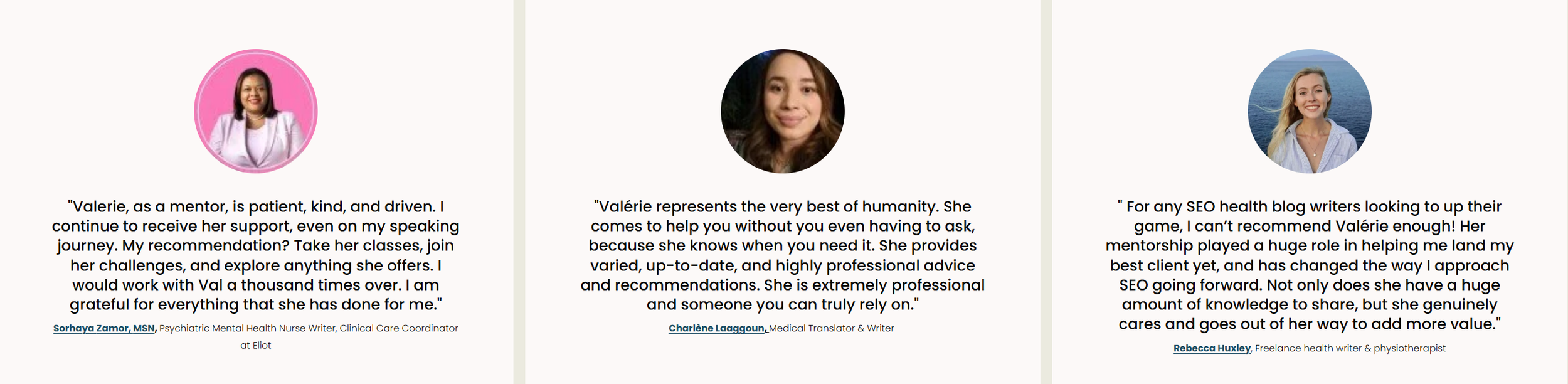
Testimonials from mentees
Learning how to write SEO (Search Engine Optimization) content means understanding what information people are looking for when they use Google, other platforms with search functions (such as YouTube, LinkedIn, Instagram…), or AI tools like ChatGPT and Perplexity, and how to structure your content so it gets found by the right people. These same techniques can also be used to optimize your own content as a freelancer and attract clients organically. This path is ideal if you’re thinking: “I want confidence before pitching clients, real editor’s feedback, and proof of what I can do in SEO.”
What drives me when doing SEO is that I know (rather than guess) that my content is very much needed and it will be helpful to many people (like this article!), and the feeling of being helpful is so rewarding.
When I created the Bioty mentorship program in 2023, I started by providing the highest level of support I wish I had when I started (1:1 support and feedback). I now provide a progressive training ecosystem built specifically for health and medical writers.
Who this is best for
writers targeting health brands and healthcare companies
writers working with SEO or content agencies
clinicians moving into patient-facing or digital content
health journalists
medical translators and linguists
writers who “know some SEO” but don’t feel confident applying it
freelancers who want to understand a service that can lend itself to ongoing client work
What I teach
My SEO training focuses on the things writers actually need to produce client work.
That includes:
keyword research for health topics
SERP analysis
understanding human search intent
reader psychology and empathy
structuring SEO content
applying E-E-A-T principles appropriately
researching and communicating health evidence
optimizing content for traditional and AI search environments
creating a complete SEO health article from brief to delivery
Importantly, I want you to understand why you are making each decision. That makes it much easier to explain your recommendations to editors and clients and position yourself as a strategic partner rather than someone who simply inserts keywords into copy.
The Bioty learning path in 2027
There are different ways to learn depending on how much support you need:
Free SEO resources and my monthly newsletter
5-day SEO Health Writing Challenge: a practical writing challenge designed to help you apply SEO principles rather than only read about them. The SEO Health Writing Challenge will run as a paid experience in 2027. If you want to know when the next cohort opens, my email subscribers hear first and receive access to private early-bird offers.
1:1 SEO Health Writing Mentorship for writers who want personalized feedback and deeper client-readiness. I accompany you through the whole process of creating a full SEO health blog post from scratch with 2 rounds of edits. You work with real briefs, templates, and checklists, and receive personalized feedback, so you’re never left wondering whether you’re “doing it right.”
Here’s what some of my mentees said about my mentoring:
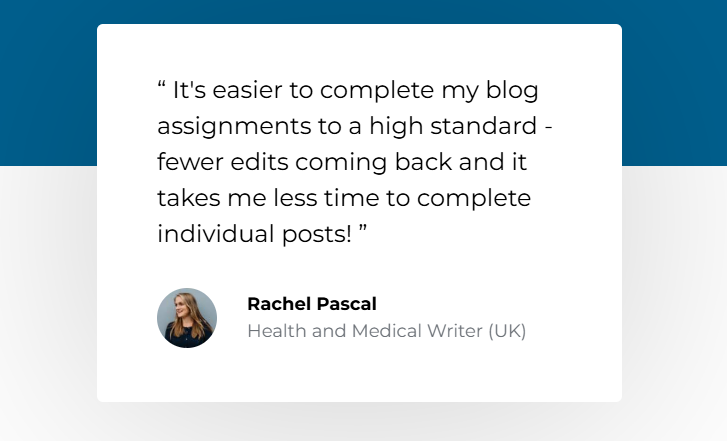
Rachel’s testimonial after completing the Bioty SEO mentorship program.
Extract from Rachel’s full case study.
Format and Investment
Free resources and writing challenges
Workshops and webinars ranging from US $37 to $127 (~ €31 to €108)
1:1 Mentorship program at US $ 650 (~ €560) including 1-year access to materials, community, certificate, and free access to online workshops
5. If You Want to Write Patient Education People Can Understand and Find: Bioty Healthcare + Kathrin Kunze

Patient education deserves its own category because writing for patients is not simply “making medical writing easier.”
You need to think about:
what the person already understands
what they might be frightened or confused about
what information they need first
how terminology affects comprehension
how tone affects trust
how people actually search for answers to health questions
That is why Kathrin Kunze and I created How to Write Patient Education That Gets Trusted and Found Online.
Kathrin is a nurse turned medical communicator with around 20 years of clinical experience, including oncology, emergency care and intensive care.
I bring the search and content perspective: understanding how people look for health information online and how their searches often reveal questions, fears, and needs that traditional medical content can miss.
Who it’s best for
health and medical writers
medical translators and linguists
healthcare professionals moving into writing
clinicians writing patient information for their own websites
healthcare marketers
health communicators
You do not need previous SEO experience.
What you’ll learn
The course focuses on four areas:
1. Understanding what patients actually need
You’ll think more carefully about the person behind the search: what they may be worried about, what information matters first, and what could make the content easier to process.
2. Making medical information easier to understand
You’ll learn how to use plain language, reduce unnecessary jargon, and explain complex information clearly without losing accuracy.
3. Writing with empathy
Tone, structure and word choice can determine whether health information feels supportive or overwhelming.
4. Helping useful information get found
You’ll learn how patients search for health information using Google and AI tools and how to align educational content with the language and questions they actually use.
The course finishes with a practical before-and-after exercise, where you can see these principles applied to a piece of medical writing.
Format and investment
approximately 60 minutes of focused prerecorded lessons
short videos you can complete at your own pace
practical before-and-after exercise with explanations
suitable for SEO beginners
access to the Bioty Community of health and medical writers
$97 USD at time of launch
6. If You Want More Support with Freelancing & Pricing Strategy: Rachel Pascal
Rachel Pascal is a freelance health and medical writer with over a decade of industry experience. She mentors writers at different stages of their journey, from those just starting out to freelancers who feel stuck or ready to level up. What she offers is not a writing course per se, but it can be valuable if you already know how to write, and want to turn your medical writing into a sustainable freelance business.
Who it’s best for
Early-stage freelance medical writers who want clarity and direction
Healthcare professionals transitioning into freelance writing
Academic or research staff moving into commercial or content-focused work
In-house or agency writers planning to go solo
What the support focuses on
Rachel’s mentoring and resources are centered on the business side of freelancing, including:
Pricing your services and setting sustainable rates
Pitching confidently and finding client leads
Portfolio strategy and positioning
Negotiation and client communication
Building a freelance business that fits your life (not the other way around)
She also offers a strong library of free and low-cost resources, such as job search guides, portfolio examples, rate calculators, negotiation toolkits, and a practical newsletter, all designed to help writers move out of the “feast or famine” cycle.
Format & cost
Free resources and affordable paid guides
1:1 mentoring sessions: £150 for a 60-minute session
Three-session package available for longer-term support
Each mentoring session is tailored to your specific situation, with actionable next steps and follow-up notes. I’ve been working with Rachel for over a year on her website’s SEO, during which she also became my mentee, and I can vouch for her (she genuinely cares!).
7. If You Want to Work in Pharma Advertising: The Medical Copywriting Training Program
If your goal is to work with pharmaceutical advertising agencies, this is one of the clearest entry points I’ve seen into a highly regulated niche. Created by Holly Hagan, an experienced medical copywriter who has worked on prescription brands in Canada and the US, this program is designed to bridge a common gap: many writers are hired into pharma advertising without formal training in how regulated promotional work actually functions.
Who it’s best for
Writers targeting pharma and healthcare advertising agencies (US, UK, Canada)
Clinicians, pharmacists, or scientists interested in promotional writing
Freelance or in-house writers who want to add pharma copywriting to their skill set
What the training focuses on
The Medical Copywriting Training Program mirrors real agency workflow, so you’re practicing how medical copywriters actually work day to day.
Key areas include:
Writing creative but compliant promotional copy for HCP audiences
Understanding briefs, key messages, and brand boundaries
Referencing, annotating, and substantiating claims
Fair balance, ISI, and regulatory considerations (FDA, PAAB, UK requirements)
Working through review cycles, layouts, and client feedback
You complete practical assignments throughout the program and finish with a portfolio-ready promotional piece, which is essential when applying to agencies.
Learning format:
10 self-paced modules combining short lessons and exercises
A mix of asynchronous learning and live office hours with the instructor
Group discussions, assessments, and direct feedback
Templates, checklists, and workflow tools
Recordings available if you can’t attend live sessions
The program is designed to be manageable alongside full-time work and can typically be completed in around 10 weeks, depending on your availability.
Cost: $997 CAD (or €630) for 12 months of access (course content, discussion group, and office hours).
8. If You Want to Specialize in CME Writing: WriteCME Pro
CME (Continuing Medical Education) comes with its own rules, standards, and expectations. Created by Alexandra Howson (PhD, CHCP, FACEHP), WriteCME Pro is a CPD-certified program designed to help writers confidently navigate the complexity of accredited medical education and build a sustainable CME writing career without burning out.
Who it’s best for
Clinicians, nurses, pharmacists, and other healthcare professionals
Academics and researchers pivoting out of academia
Experienced medical writers looking to specialize in CME/CE
Writers who enjoy educating health professionals and shaping clinical practice
What the training focuses on
WriteCME Pro focuses on the core deliverables and compliance requirements of CME writing, including:
Needs assessments and gap analysis
Accredited CME/CE compliance and standards
Educational design and learning science
CME deliverables such as manuscripts, patient cases, outcomes reports, and slide decks
Understanding who CME clients are, how to find them and how to work with them
Learning experience
Structured ROADMAP curriculum with a clear route into CME writing
Practical workshops and feedback on real CME-focused projects
Supportive community of writers specializing in CME
Many participants highlight the depth of feedback and the clarity the program brings to a niche that often feels opaque from the outside.
Cost (annual): US $1,997 (~ €1,700)
9. If You Want Academic Prestige & Formal Credentials: University of Chicago
If your priority is institutional credibility, technical rigor, and formal credentials, the University of Chicago’s Medical Writing and Editing Training Certificate offers one of the most structured academic paths into medical writing.
This is a non-credit, CPD-aligned university certificate designed for writers who want deep training in editorial standards, ethics, and scientific communication, particularly for regulatory, academic, or publication-focused roles.
Who it’s best for
Writers pursuing regulatory writing, medical editing, or academic-style work
Professionals who value university-backed credentials
Those planning to work closely with journals, regulators, or research teams
Writers who prefer a structured, syllabus-driven learning environment
What the program focuses on
The certificate emphasizes technical excellence and editorial standards, with a strong grounding in:
Medical copyediting and substantive editing
AMA Manual of Style mastery
Publication and research ethics
Interpreting and reporting biostatistics
Preparing tables, graphs, and figures
Students then choose a writing concentration, such as:
Regulatory writing
Patient education
Healthcare advertising
There is also an option to add a Regulatory Writing Microcertificate for deeper specialization.
Learning format & structure
100% online program with live weekly synchronous sessions
Five core courses plus one concentration course
Each course runs 5–7 weeks
Can be completed in as little as 9 months, with up to 3 years allowed
Includes a student community hub and hands-on editing and writing exercises
The experience closely mirrors academic and professional publishing environments, making it especially relevant for writers who enjoy precision, structure, and formal review processes.
Cost & credentials
Cost:
approximately US $9,090 (~ €7,743) for the full certificate
Cost per course: typically $1,490–$1,640, depending on the course
Certificate and digital badges are awarded upon completion.
Medical Writing Courses vs Certificates vs Certification: What’s the Difference?
Medical writing course
A course usually teaches a particular subject or group of skills. It might last one hour, six weeks, or several months.
You may receive a certificate of completion, but the course itself is primarily educational.
Certificate of completion
A certificate of completion shows that you completed a particular course or learning program. It does not automatically mean you have been independently assessed as professionally competent in the field.
That doesn’t make it worthless. It just means you need to understand what the certificate actually represents.
Certificate program
A certificate program is generally a more structured sequence of education. University and professional-association programs often fall into this category. These may carry more weight in environments where formal professional development matters.
Professional certification
Certification usually refers to a credential with defined requirements, which may include professional experience, eligibility criteria, and formal assessment. That is different from simply completing an online course and receiving a downloadable certificate.
So, do You Need a Medical Writing Certification to Get Work?
Not necessarily. The value of certification depends heavily on the type of medical writing you want to do. For freelance health content, patient education and SEO writing, clients are often highly interested in:
your writing quality
subject-matter knowledge
ability to research evidence
portfolio samples
understanding of the target audience
reliability
ability to follow a brief
strategic thinking
For regulatory, scientific publication, institutional, or more formal medical-communication roles, structured professional training or recognized credentials may carry more weight. This is why I wouldn’t choose a course based on the certificate alone.
Why SEO Health Writing Can Be a Strong Starting Point: for Client Work and Your Own Business
Learning one medical-writing niche doesn’t mean you are stuck in it forever. SEO health writing develops skills that transfer naturally into other areas of medical communication. But there’s another advantage I think freelance writers sometimes overlook:
You can use the same SEO principles you learn for clients on your own website to help the right clients find you.
That makes SEO a slightly unusual medical-writing skill. You can sell it as part of your service and use it to support your own freelance business.
Patient education
SEO health writing teaches you to understand what a lay reader is actually trying to find out, which questions matter most to them, and how to communicate complex medical information clearly.
Those skills transfer naturally into:
patient web pages
educational materials
FAQs
disease-awareness content
patient support resources
This overlap is one of the reasons I now teach patient education alongside SEO. Search behavior can reveal the words people use, the questions they ask, and sometimes the worries sitting behind those questions.
Public health communication
Search intent forces you to think carefully about who is looking for the information and why.
That audience-first mindset is useful for:
public-health campaigns
awareness initiatives
health literacy work
population-level communication
Instead of starting with “What do I want to tell people?”, you get into the habit of asking “What does this audience actually need from me?”
CME writing
Long-form SEO health content can strengthen your ability to:
synthesize evidence
organize information logically
build a clear narrative
prioritize information
guide someone through a complex subject
Those skills transfer well into educational writing, even though CME has its own standards and requirements. CME writers are also often asked to produce SEO blogs as part of their work, and CME providers often tend to have limited knowledge of SEO.
Pharma copywriting
SEO writing can also strengthen:
audience awareness
message hierarchy
concise communication
understanding of reader motivation
structuring information around a defined objective
The regulatory environment is very different, so SEO training doesn’t replace specialist pharma training. But some of the underlying communication skills are highly transferable.
SEO can also help you market yourself as a freelance medical writer
This is the part I wish more writers considered. If you understand keyword research, search intent, content structure, internal linking, and how useful content builds topical authority over time, you don’t have to apply those skills only to client websites.
You can apply them to your own freelance website and blog.
That can help you stabilize your client pipeline even when you’re not visible on social media, demonstrate your expertise to ideal clients before they even contact you, and gradually make your freelance business less dependent on referrals, LinkedIn, or constant outreach.
I’ve seen this work in practice with my own business when I go away or when I’m too sick to function (and that’s probably how you came across this article even if I didn’t promote it on LinkedIn). I also worked on the website of freelance medical writer Rachel Pascal, where we focused on making her existing expertise easier to discover through search. Over the period covered in the case study, her site generated more than 228,000 Google impressions and over 2,000 organic clicks, while relevant inquiries also began coming through the website.
One message from Rachel summed up why that matters:
“I just got a really good enquiry about a white paper, so our targeting is clearly working!”
SEO also gives early-career writers something useful before they have a long client list: the opportunity to create visible proof of what they can do. You can publish your own portfolio to demonstrate your approach and make your content more visible to people who need it most.
Learning SEO for clients and learning SEO for your own website are slightly different goals. This is why I separate my SEO training into two:
→ My SEO health writing mentorship and educational resources are primarily designed to help health and medical writers become stronger at creating SEO content for clients.
→ My 1:1 SEO coaching, on the other hand, is for freelance medical writers and health professionals who want to apply SEO to their own website and business. We look at what may be stopping the right people from finding or choosing you, decide which improvements are actually worth prioritizing, and implement them as you learn.
So even if SEO health writing doesn’t become your only niche, it can give you two useful tools: a service you can offer clients, and a way to help your own expertise get found.
Final Tips: How to Choose the Best Medical Writing Course for You
Before enrolling, pause and get clear on why you want to take an online medical writing course.
Start by asking yourself:
What kind of medical writing do I want to do? (regulatory, SEO content, CME, pharma copywriting, etc.)
What do I actually need right now? Skills, confidence, a portfolio, or career direction?
Once you’re clear on your goals, choose one or two courses that directly support them. You don’t need to do everything at once: think of your learning as a training roadmap you can follow over time.
It’s also worth remembering that many successful medical writers stack complementary training as they grow. By that, I mean they never really stop investing in learning. For example:
SEO health writing with me + mentoring with Rachel to gain confidence and raise your rates
Foundational courses with Virginia + niche specialization as your confidence and experience grow
Even experienced writers have joined my mentorship so that they can benchmark their skills and keep building confidence. I personally continue to invest in training myself: I attend regular SEO training sessions and webinars, and I connect with SEO consultants and digital marketers to stay up to date. I also actively learn from freelancers who are more advanced in areas I want to improve.
The best course for you doesn’t have to be the most expensive or prestigious. What matters most is that it helps you take your next realistic step forward. My personal preference is for programs led by freelance writers who are still active in the field, as this ensures the guidance is practical and aligned with today’s market.
If you’re unsure which path makes sense for you, getting personalized guidance from writers-turned-mentors before choosing a course can save you time, money, and frustration.
Feel free to reach out to me on LinkedIn. I’m always happy to answer questions or point you toward trusted freelancers if I’m not the right person to help. I try and respond to everyone with the same care I wish I’d had when I was starting out.
Val ✍🏻
You want to keep learning before investing in a course?
Join my monthly newsletter for practical SEO and medical writing tips, updates on new training, and private early-bird discounts available to subscribers.
Medical Writing Courses FAQs: Choosing the Right Path
-
There isn’t one medical writing course that is best for everyone. The right choice depends on the work you want to do.
If you’re still exploring, a low-commitment course such as Coursera may be enough to help you understand the field.
If you’re transitioning from healthcare or science, broader medical-writing training such as Write Clinic or professional education through AMWA may be more useful.
If you already have some ideas of your niche, choose specialist training: SEO health writing, patient education, pharma copywriting, CME, regulatory writing, or another area relevant to your career goal.
-
There’s no single path, but most medical writers follow a similar progression:
Build foundational skills
Learn how to write clearly, ethically, and accurately about health or science.Explore niches
Common niches include SEO health content, regulatory writing, CME, pharma copywriting, or patient education.Get practical experience
This might mean creating portfolio pieces, completing guided exercises, or writing under feedback.Learn how the work actually happens
Freelancing, pitching, pricing, briefs, compliance, or agency workflows (depending on your goal).Keep refining your skills
Medical writing is a field where learning doesn’t stop, especially as regulations, SEO, and AI evolve.
You don’t need to do everything at once though. Most writers build skills gradually.
-
Not every type of medical writing requires a certification. Many freelance clients care more about the quality of your work, your understanding of the subject, your portfolio, and your ability to meet the needs of their audience.
Formal credentials can be more relevant in certain regulatory, publication, scientific, or institutional environments.
Before paying for certification, check whether employers or clients in your intended niche actually value it.
-
In two weeks, you can usually complete:
Introductory courses in scientific writing or medical terminology
Short workshops, writing challenges, or mini-courses in specific skills (e.g. SEO basics, editing fundamentals)
Certificates of completion for short online programs
These certifications are useful for a bit of learning and confidence, but on their own, they rarely lead directly to paid medical writing work. Clients and employers typically care more about:
Writing quality
Subject-matter understanding
Niche experience
Relevant samples
In other words, short certifications work best as a starting point only.
-
Short answer: yes, they’re optional but they can add interesting networking and learning opportunities, especially if you’re freelancing.
Professional medical writing associations like the AMWA, IMWA or EMWA offer:
· Networking & potential job leads
· Industry standards & ethics guidance
· Short workshops and webinars
· Credibility when pitching clients or employers
· Opportunities to meet in face-to-face conferences (the main reason why I’m considering joining one)
They work best alongside or after training.
-
Yes, depending on the type of medical writing.
Medical writers come from many backgrounds, including healthcare, science, journalism, communications, translation, marketing, and professional writing.
However, you still need enough medical and scientific literacy to research information accurately and understand the material you are communicating.
The level of specialist knowledge required will vary considerably between, for example, consumer health blogging and regulatory medical writing. If you want to become a health writer and you don’t have healthcare credentials, I’ve written more about it in this guide: How Health & Medical Writers Can Build Credibility Without Being Healthcare Professionals
-
They can be, particularly when the course solves a specific skill gap.
Before enrolling, look at whether the program includes:
relevant real-world examples
practical exercises
instructor feedback
portfolio development
clear learning outcomes
training that reflects the type of writing you want to do
A self-paced course can be excellent for learning concepts, but mentoring or feedback may be more valuable if your main problem is not knowing whether you are applying those concepts correctly.
-
There is no single timeline. Someone coming from healthcare or scientific research may already understand the subject matter but need to develop writing, audience, or commercial skills.
An experienced writer may need the opposite: stronger medical knowledge or training in a specialized area.
Rather than asking how long it takes to “become” a medical writer, I would focus on becoming competent enough to complete a specific type of project well, get client testimonials from my work, then explore other types of projects as someone who likes variety and novelty.
-
Medical writing is a broad umbrella covering many forms of health and scientific communication, including regulatory documents, scientific publications, patient education, CME materials, and digital health content.
Medical copywriting typically has a stronger marketing or persuasive objective.
In pharmaceutical advertising, for example, medical copywriters may create promotional materials within strict regulatory and compliance requirements.
The skills overlap, but the purpose, audience, and rules surrounding the work can be very different.
Disclaimer: Prices and program details are subject to change. Please check each provider’s website for the most up-to-date information.



 Link copied!
About the Author
Valérie Leroux, MSc, is a bilingual SEO health writer and founder of Bioty Healthcare since 2022, helping health brands and medical writers create high-ranking, trustworthy content backed by science and empathy.


Compare the best medical writing courses by career goal (freelancing, SEO, pharma, patient education, CME, or academia) with real-world guidance and honest insights.