
What is SEO and How to Do SEO as a Medical Writer (In a Nutshell)
You can be a great medical writer and still feel a bit lost with SEO (Search Engine Optimization). This is completely normal, and I also felt this way at first - that’s because most SEO trainings are not meant to train health and medical writers and can feel quite technical. Maybe you hate SEO for this reason.
I’m here to change that.
People search for health information online (mostly via Google, and increasingly via AI tools) because they’re worried, or trying to make an important decision. Your job with SEO is mostly to meet them with a clear and helpful answer they can trust so that they can find it at the top of Google, or cited by AI.
I’m Val. I spent over 10 years in the healthcare corporate world, and I’ve specialized in SEO health writing since 2022. I write and edit SEO health content in English and French, and I’ve edited work from more than 100 medical writers.
In this guide, I’ll walk you through:
what SEO actually means for medical writing on the web
what a keyword is (and what people really mean when they type one)
how to spot search intent (the part most writers miss)
a simple structure that makes health blogs easy to scan and trust
what to do before you write, and what to check while you write (with my free SEO checklist)
TL;DR: SEO for medical writers (in plain English)
SEO (Search Engine Optimization), for medical writers, means writing the best answer to a real health question in a way that readers and search engines can understand and trust.
In practice, it looks like this:
Start with human search intent: what the reader truly wants to know or do, and how they feel.
Answer early: give the key takeaway near the top, then explain with calm, clear language.
Build trust: use credible sources, careful risk wording, and expert input when it adds value (trust signals should follow guidelines called E-E-A-T by Google).
Use a scannable structure: clear headings, short sections, and FAQs
Send clear signals for search engines to understand and rank your content: place your main keyword in key spots (title, H1, first paragraph, one H2, URL, FAQ/conclusion) and add helpful internal and external links.
For you as a writer, the payoff of learning SEO is big: your work gets found and read by the people who need it, not just the people who happen to see it on social media. That means more real-world impact. It also makes you more valuable to clients, because your writing supports measurable outcomes, often leading to stronger portfolio pieces, higher rates, and ongoing monthly work (new posts & updates).
This is the simplified version of SEO, but once you're ready to go deeper, I’ve outlined the exact SEO best practices I use in medical writing to get content ranked, trusted, and cited by AI tools.
What is SEO (Search Engine Optimization) for medical writers?
For medical writers, SEO means this: write for people first, then make the page easy for search engines to understand.
If you prefer listening rather than reading, here’s a short intro to SEO (taken from my SEO Best Practices webinar):
SEO helps your health blog show up when people search for health questions on search engines like Google. It also helps your content appear in AI answers, in which case you may see this called “GEO” (Generative Engine Optimization) or “AI SEO”.
The better your page matches exactly what the person is looking for, the more likely it is to appear near the top. When you do that, the right readers find your content: patients, customers, donors, or healthcare professionals.
More of the right readers build credibility and visibility for your client :
Visibility: Your content shows up when people search for that topic on Google (and in AI answers), so your client is easier to find.
Credibility: When the page gives a clear, well-sourced answer, readers see your client as knowledgeable and trustworthy.
Over time, that trust turns into action: readers feel confident enough to book an appointment, buy, sign up, donate, or get in touch with your client.
It also benefits you as a writer. SEO helps your work get seen, read, and shared. It increases your impact, because your content can reach the people who need it most. And it makes you more valuable to clients, because your writing supports real results. This type of work often turns into monthly assignments and longer-term client relationships, because SEO works best with consistency.
| What changes | Regular blog assignment | SEO-friendly blog assignment |
|---|---|---|
| Goal | Publish something helpful | Publish something helpful and easy to find |
| Success metric | “It’s live” | Traffic, visibility, clicks, leads over time |
| Writer’s role | Writer | Writer + content strategist (even in a light way) |
| Client value | Short-term content | Long-term asset that keeps working |
| Impact | Readers who happen to see it | Reaches people actively looking for the topic |
| Portfolio value | Shows writing skill | Shows writing skill plus performance and strategy |
| Typical workflow | One-off | Often ongoing monthly work + refreshes |
| Rates | Standard writing rate | Often higher rates (strategy + business impact) |
What is a keyword?
A keyword is the phrase someone types or says into Google when they want an answer.
Summary of Core SEO concepts showing a keyword in Google’s search bar. Source: Extract from the SEO Best Practices webinar.
For example, a keyword can be:
a question: “Is Botox safe in pregnancy?”
a short phrase: “Botox in pregnancy”
Google is then trying to figure out the hidden query behind this so that it can provide the best answer. As a medical writer, it should be crystal clear what the real query behind the keyword is: What does the reader want to know or do right now? You also want to understand what the reader is feeling as they search (worry, urgency, confusion, hope). This is called human search intent. Sometimes intent is shared in the content brief. I still like to go deeper regardless, because understanding your audience’s mindset helps you write a more helpful and trustworthy answer.
Then your blog post’s mission is to provide the clearest, most helpful answer to that question, with the right amount of details to be accurate but not overwhelming.
Example: “is Botox safe in pregnancy”
Most people are not looking for a definition of Botox. They are asking: “Is this safe for me or my baby?”
So the article should reassure readers (maybe they already had Botox!) and:
say what is known and what is not known
use credible sources and, when possible, an expert quote
use calm, clear language (many readers feel anxious)
explain what to do next (talk to a clinician, safer options, red flags)
A common pitfall I see from writers is to focus on keyword placement in SEO, while the real focus should be on learning how to write helpful, easy-to-understand, and trustworthy content.
How to do SEO as a medical writer
I made two free resources to help you apply this fast: a downloadable SEO checklist, and a simple health blog structure cheat sheet. You’ll find them below.
Before writing
1. Check what already ranks
Open the top results on Google for your keyword. Notice what they cover, and what they leave out. This gives you a feel for what readers are already getting, and where you can genuinely help more. You want your blog post to add to the conversation instead of repeating the science or quick answers users are already getting from other blogs (or can get from AI).
2. Build a clear outline
Create a structure that answers the main question quickly (readers scan rather than read in most cases). Then add details for readers who want to go deeper.
Use this simple flow so readers (and search engines) can scan your page fast:
Clear title (H1) that matches the main question
Short intro that confirms you understand the reader’s concern and previews the answer
Key takeaway box(or TL;DR) so busy readers get the point fast
Subheadings (H2s) that follow the real questions people ask
Helpful details with clear explanations, examples, and calm plain language
FAQ with short answers
Conclusion + CTA (what to do next)
References + short author bio to strengthen trust
Here’s an overview of how an SEO-friendly health blog looks like:
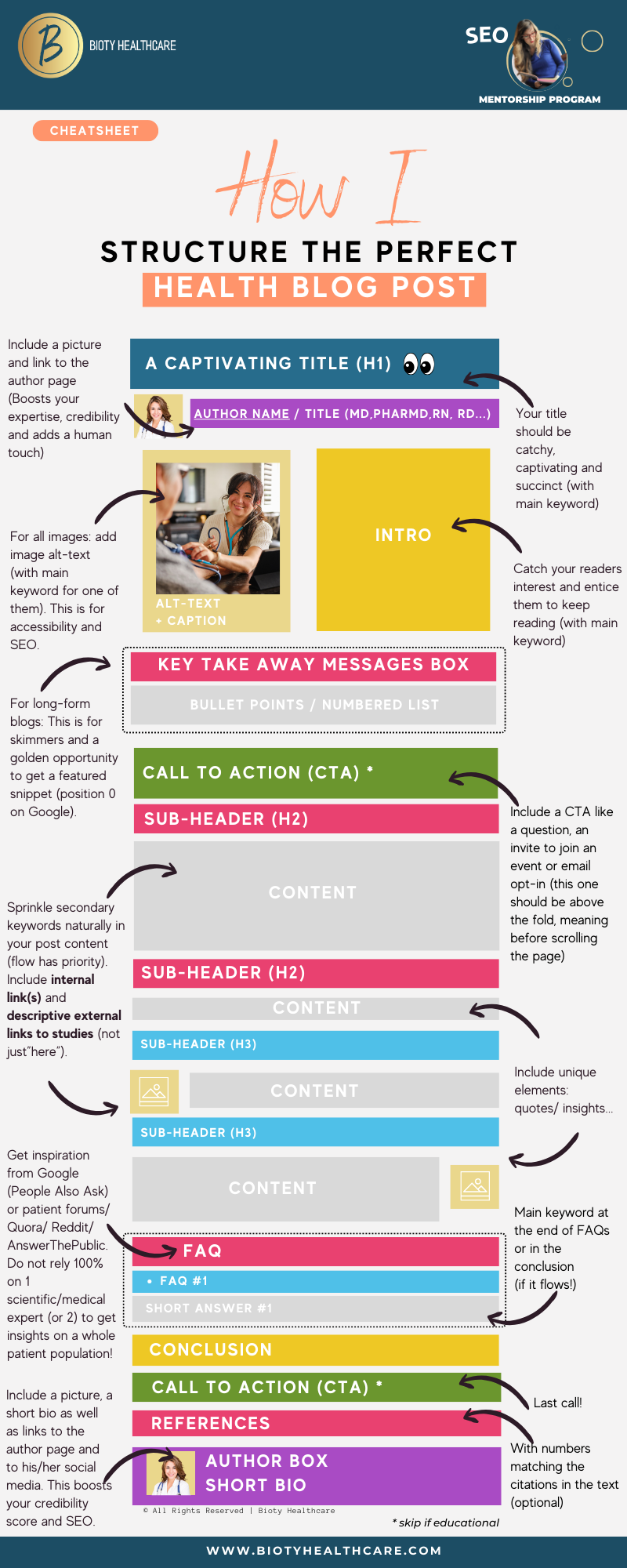
Example of a health blog structure (simplified). Source: SEO health writing mentorship program (Bioty Healthcare)
While writing
1) Make it easy to trust (E-E-A-T signals)
In health content, Google looks for trust signals (called E-E-A-T according to Google’s rating guidelines):
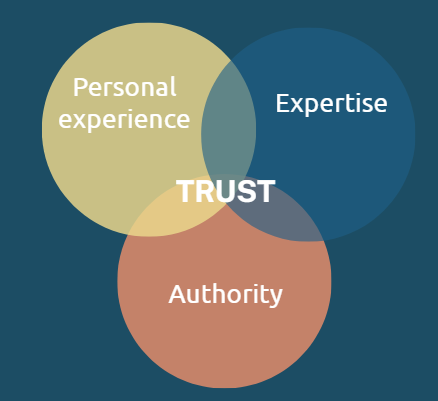
EEAT trust signals. Source: EEAT practical workshop.
Experience: real-life insight when it’s relevant
Expertise: Expertise may come from scientific training, years of writing, specialist knowledge or your ability to research and report expert insights well. Read my guide to health SEO for non-clinical health writers to see how to make your expertise clear and relevant.
Authoritativeness: reputable sources, author and expert input
Other Trust signals: clear explanations, empathy, balanced risk language, and full transparency about what’s known or not
You can support these signals by:
using credible sources
blending in personal health stories as relevant
adding expert input when needed
explaining clearly (for different health literacy levels)
I’m explaining EEAT in a lot more detail (with practical exercises and real-life examples) in an EEAT practical workshop.
2) Use your main keyword in the key places
Use your main keyword in:
the page title (what shows in Google)
the short description under it (meta description)
the main headline (H1)
one subheading (H2)
the first paragraph
the URL
the ending (conclusion or FAQs)
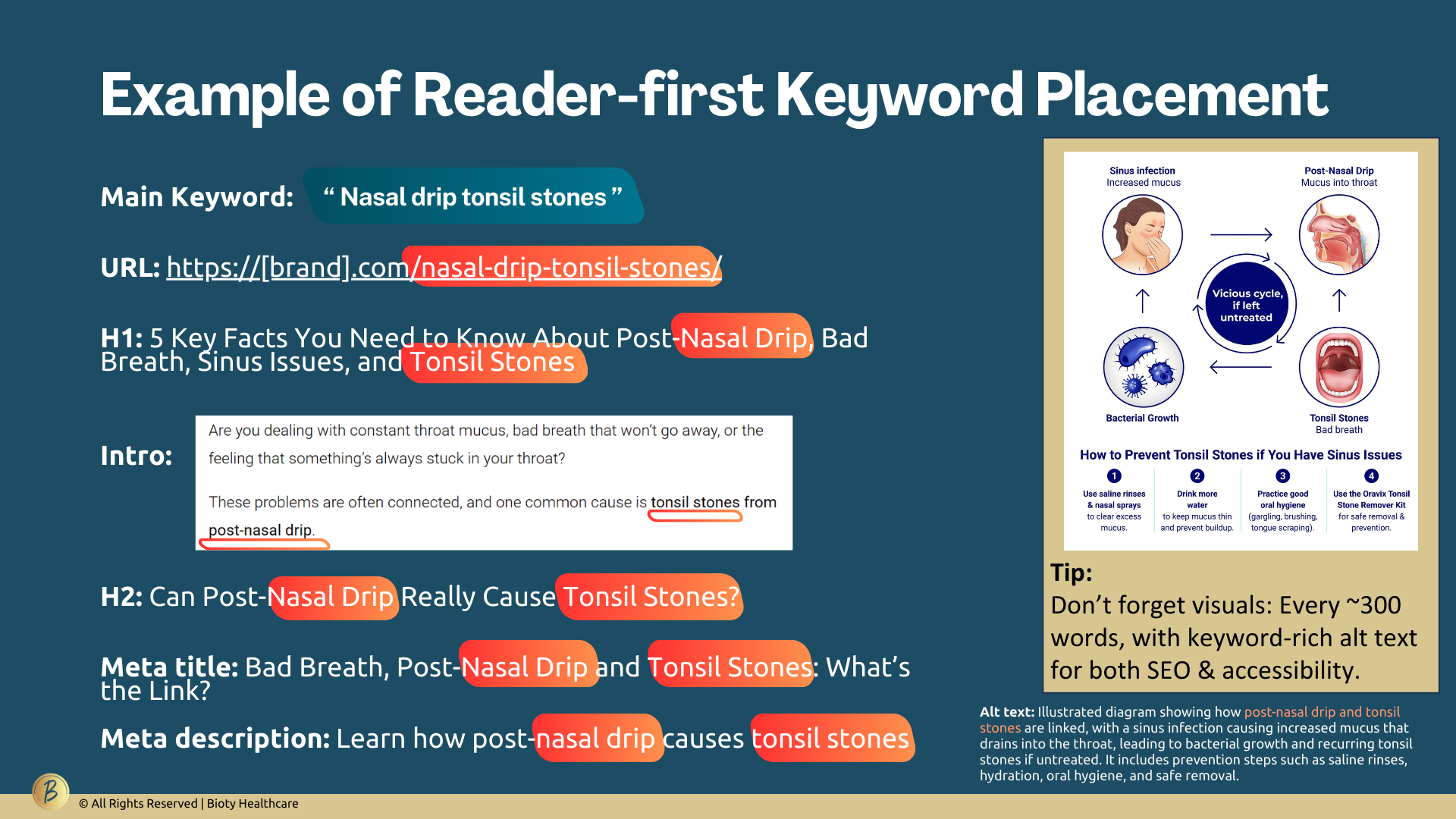
Example of keyword placement in a real health blog. Source: Extract from the SEO Best Practices webinar.
3) Add helpful links
Link within the site: point readers to other useful pages on your client’s website
Link out to trusted sources: use strong references to back up any health claims (PubMed, WHO, major medical organizations)
I released a whole checklist to help you self-edit your SEO-friendly health blog, which you can download for free:
Final Tips: Quick SEO check for medical writers
SEO health writing is writing clear and helpful answers that people can find and trust.
Run this fast check for better SEO:
Intent: Can you say the reader’s main question in one sentence?
Answer first: Does the intro give the takeaway early (then explain)?
Trust: Are your claims supported with credible sources, and is uncertainty explained clearly when needed?
Structure: Is it easy to scan (one H1, clear H2s, short sections, FAQ)?
Keyword basics: Is the main keyword in the title, H1, first paragraph, one H2, URL, and FAQ or conclusion?
Links: Did you add a few helpful internal links and trusted external references?
You do not need to be a tech expert or trick any algorithm to write SEO-friendly health content. You need one core skill: understand what the reader is really asking, how they feel, what they may already believe in, then provide the answer clearly and credibly. When you pair that with a strong structure and reliable sources, your work becomes easier to find, easier to trust, and more valuable to clients.
If you want to go deeper and gain practical experience with my support, I run practical webinars and writing challenges for medical writers on SEO, trust signals, and writing that performs. Join the list below so you get my updates first.
Val ✍️
FAQs: SEO in medical writing
-
SEO is a way to write and format online health content so the right people can find it in search. It helps your article show up when someone searches a question, then stay readable and trustworthy once they click.
-
To get insights as part of your SEO research, Google is a great and free resource, if you learn how to analyze the results it shows on the first page. For keyword research, many writers use tools like Semrush, Ahrefs, or Ubersuggest. I personally use Semrush because I’m used to it, and it gives 10 free requests per day, which is often enough for quick topic checks. I only use the paid version when I’m doing heavy SEO content strategy work.
-
SEO takes time. Some pages improve within weeks, but stronger results often take a few months. It depends on the topic, the competition, and how consistently the site publishes and updates content.
SEO also goes beyond content. It can include technical checks to make sure the website is easy to navigate and mobile-friendly, plus digital PR to earn links from other reputable websites. Have a look at my case studies to see examples of the results this can lead to.
-
ChatGPT can help with ideas and pattern recognition in SEO health writing. It can also help you simplify language or proofread content. But you still need to check accuracy, confirm the evidence, and make sure the content answers the real intent. 100% AI-generated content is typically not doing well as it doesn’t have the level of trustworthiness required in health content (EEAT signals) and it tends to be generic without anything unique to it – which gives no reason to Google to select this blog post over another. If you want to know more about the ethical use of AI in medical writing, there are upcoming workshops you can join.
-
Link to two places in a health blog post:
Internal links: helpful pages on your client’s site (services, related articles, key product or clinic pages).
External links: trusted sources that support health claims (PubMed, WHO, major medical organizations, guidelines).
-
The value of a strong SEO health blog (and the level of research it requires) simply doesn’t correlate with word count. That’s why I avoid charging per word. The right length depends on the depth needed to answer the reader’s real question. That’s why I offer a standard price based on an average 2,000-word article, and I define the scope clearly upfront. Clear scope protects your time and makes it easy to charge more when the workload increases. A few things to help you clarify the scope:
SME input: quotes vs full interviews
Patient/community interviews: included or not
Who provides the contacts for interviews and quotes: you, the client, or both
Topic complexity: level of clinical expertise and compliance risk (sensitivity)
Revision rounds: how many are included (often 2)
Review workflow: number of stakeholders and approval steps
If any of these change, the fee should change too.



 Link copied!



About the Author
Valérie Leroux, MSc, is a bilingual SEO health writer and founder of Bioty Healthcare since 2022, helping health brands and medical writers create high-ranking, trustworthy content backed by science and empathy.

See how a health e-commerce brand recovered rankings and scaled with a multilingual SEO strategy, reaching 6.4M impressions and US market growth.