
SEO Best Practices for Medical Writing: 5 Techniques to Get Found on Google and Cited by AI in 2026
If you’re new to SEO, I recommend starting with my guide on what SEO means for medical writers and how to apply it step by step. It covers the basics in plain language.
In this article, we’ll go one step further.
In 2026, people can access a large amount of health information through AI tools. This raises the standard for content. To stand out and get cited, your content needs to be unique, clear, trustworthy, and genuinely helpful.
Since 2022, I’ve specialized in SEO health writing and edited content from more than 100 medical writers. Here, I’ll share five SEO best practices for medical writing that I use in my own work and when editing content from other writers. These are practical techniques that help your content get found by people who need it most, whether they search for information on Google or AI chatbots.
TL;DR: SEO Best Practices for Medical Writing
From my experience writing and editing SEO health content, here are 5 key principles to improve your content’s visibility on search engines and AI in 2026:
Start by understanding human search intent before writing
Answer the question early with a clear, direct (but empathetic) statement
Build trust with E-E-A-T signals e.g., reliable sources, expert quotes, a robust author profile
Write with clarity and empathy to get your message across
Structure your content for scanning, so that it is easy to read and understand, both for readers and search engines
These principles work together. When you understand the reader first, it becomes much easier to structure your content, choose the right tone, and decide what level of detail is needed.
This is especially important in health topics, where accuracy and safety carry more weight. These principles help you explain uncertainty clearly, use careful language, and guide readers on when to seek care.
If you’d like to see how to apply these techniques in practice, I cover this in more detail in my live SEO Best Practices course, where we work through real examples and editing decisions step by step.
SEO Best Practice #1: Start with Human Search Intent
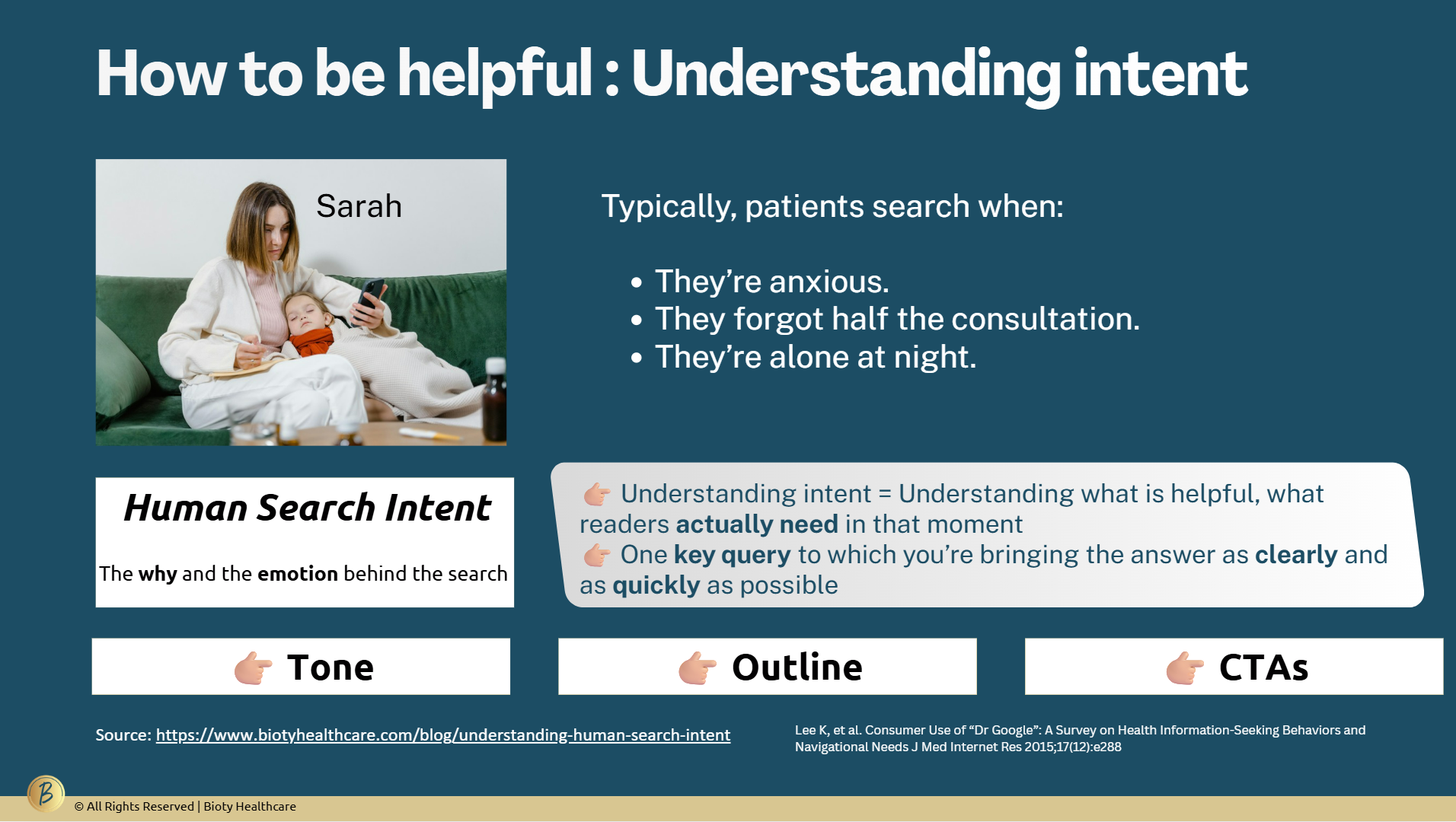
Understanding Human Search Intent in SEO Medical Writing - SEO best practices course (2026)
Search intent is the reason someone types a question into Google. It reflects what they want to know or do in that moment.
Behind every keyword, there is a real person trying to solve a problem. In health, this often happens when someone feels worried, confused, or unsure about what to do next.
When I approach a blog post, I like to picture that person clearly. I even give them a real first name, like Sarah or Bob. I then want to understand both the questions they have and the emotions behind those questions.
For example, Sarah might be a parent who notices symptoms in her child and searches online to understand whether she should see a doctor. She is not only looking for information, but also reassurance and clarity.
Search intent also helps guide the outline of your article. For example, imagine the query “how to get rid of stretch marks.”
When you look at the search results, you’ll see a list of treatment options. This tells you that readers are mainly looking for solutions, while “get rid of” also tells you they’re hopeful they’ll find permanent solutions, so you’ll need to address this misconception first (tactfully).
In that case, as an SEO editor, I’ll check whether the section that answers the question appears early in the article. I’ll also expect the section on treatment options to be the most detailed part of the page.
Other sections, such as causes or prevention, can still be included. But they are secondary to the main question the reader came to solve.
In short, understanding human search intent helps you decide what to prioritize and how comprehensive your article needs to be. If you apply this technique before writing, your content will become more helpful. And that is exactly what search engines are trying to reward.
SEO Best Practice #2: Answer the Reader’s Question Early
People rarely read online articles from start to finish. Most readers scan the page to find the answer they need as quickly as possible.
Search engines work in a similar way. Their goal is to identify the best answer and present it immediately.
One useful approach for this is Bottom Line Up Front (BLUF). This simply means giving the main answer early, then adding more details afterward.
In practice, the first sentence of a section should clearly answer the question. The following sentences can then explain the topic, add examples, or provide nuance.
For example, imagine someone searches “What are probiotics?”. A helpful section should begin with a clear definition.
You might write something like this:
Probiotics are live microorganisms, often called “good bacteria”, that may support gut health when taken in the right amounts. After that, you can explain how probiotics work, where they are found, and when they may be useful.
The same principle works well in FAQ sections. If the question is “Can probiotics help digestion?”, the first sentence should give a direct answer before expanding on the details.
This structure helps readers find information quickly. It also helps search engines identify the key answer in your content.
When readers find what they need without scrolling through long explanations, they are more likely to stay on the page and continue reading.
SEO Best Practice #3: Build Trust with EEAT Signals
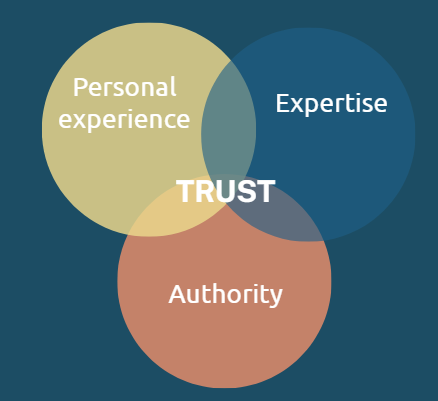
EEAT trust signals. Source: EEAT practical workshop.
You may have heard of E-E-A-T, which stands for Experience, Expertise, Authoritativeness, and Trustworthiness. This framework comes from Google’s search quality rater guidelines (182 pages).
It is important to understand that E-E-A-T is not a direct ranking factor. It is used by human quality raters to evaluate content and assess how helpful and reliable it is.
Even though it does not directly influence rankings, it is still a very useful guide, helping your content to rank indirectly. It reflects the type of content Google aims to reward, especially in health topics where accuracy and safety matter.
It also plays a growing role in AI search results, what SEO consultants refer to as AI SEO, GEO (Generative Engine Optimization), LLM optimization, and AEO (Answer Engine Optimization). When AI tools generate answers, they tend to rely on sources that show strong trust signals. Content that is clear, well-referenced, and credible is more likely to be selected and cited.
Here’s E-E-A-T for medical writers in a nutshell:
Experience refers to real-life insight. This could come from a patient perspective, a healthcare professional, or practical advice based on real situations. In my guide to personal health stories in SEO, I explain how to use patient and caregiver experiences responsibly, including consent, context and the balance between lived experience and scientific evidence.
Expertise is about the quality of the information. Expertise may come from scientific training, years of writing, specialist knowledge or your ability to research and report expert insights well. Read my guide to Health SEO: How Writers Can Show Expertise Without Clinical Credentials to find out more.
Authoritativeness often comes from the website or brand. Well-known health platforms may have an advantage, but writers can strengthen this by using credible sources and including expert input. Authority also comes from author profiles and optimizing your bio’s credibility and your online visibility as an expert has become increasingly important to earn trust from search engines.
Trustworthiness brings everything together. It means being transparent about who wrote the content, where the information comes from, and when it was last updated.
You can see these signals clearly when you analyze top-ranking articles. For example, many strong health articles include an author with relevant credentials or a medical reviewer. This helps reassure readers that the content has been checked.
You will also often see links to clinical studies or official sources. These references allow readers to verify the information and explore further if needed.
Good health blog articles clearly show the author, publication date, and sometimes the full editorial process.
As a writer, you do not need medical credentials to apply these principles. You can build trust by using reliable sources, quoting experts when needed, and writing in a clear, accurate, and empathetic way.
The goal is simple: helping readers feel confident in what they are reading. When your content is clear, well-supported, and transparent, it becomes more credible. And that credibility helps both readers and AI systems trust and surface your work over time.
If you’d like to go deeper into this, I run a live, hands-on E-E-A-T live workshop for health and medical writers, where we apply these concepts to real examples and exercises (next sessions: July 28 or September 19 2026).
SEO Best Practice #4: Write with Clarity and Empathy
How to write clearly in medical writing: improve readability, simplify complex terms, and create SEO-friendly health content. Extracted from - SEO best practices course (2026).
Health content should be easy to read and easy to understand. The trick is finding the right balance between keeping your message accurate and making it clear for people with different levels of health literacy.
Even highly educated readers may struggle to absorb complex medical information when they feel worried about their health. Research shows that stress and cognitive overload can reduce people’s ability to process and evaluate health information. This is why clarity and structure are essential in health writing.
In practice, this means using simple, familiar words whenever possible. For example, you might say “high blood pressure” instead of “hypertension,” and then introduce the medical term if needed. Short sentences and clear explanations help readers stay focused and understand what matters.
Interestingly, I’ve found that writing in a second language can actually help with this. English is not my first language, as is the case for many of my readers and multilingual writers I’ve worked with. Early on, I naturally followed clarity guidelines without thinking too much about them. I tend to use simpler words and shorter sentences, which makes my content easier to understand.
Empathy is just as important as clarity. Many people searching for health information feel anxious, confused, or even dismissed. Your role is to acknowledge that, without making assumptions or sounding confrontational.
A simple shift in wording can have a massive impact. Instead of saying “you are experiencing,” you might say “you may be experiencing.” This keeps your tone supportive and respectful, while still addressing the reader’s concerns.
If you’d like practical examples of how to apply empathy in your writing, you can read more here: How to show empathy in health writing.
SEO Best Practice #5: Structure Content for Scanning
Many online readers don’t read word by word. They scan. If your content looks dense or hard to navigate, most people will leave before finding their answer.
That’s why structure matters as much as the content itself. You want to make it easy for readers to find what they need quickly, especially when they feel worried or short on time.
Search engines and AI tools work in a similar way. They look for clear, direct answers they can extract and present quickly. When your content is well structured, it becomes easier for Google and AI systems to understand, select, and even cite your information.
You can support this with simple formatting choices:
Clear headings guide the reader through your content.
Bullet points, tables and numbered lists break down complex ideas into smaller, digestible parts.
Visuals can also help when they add meaning. A simple diagram or table can sometimes explain a concept faster than a paragraph.
Learn SEO Best Practices with Real Examples
This article only scratches the surface of what I covered in the SEO Best Practices in 2026 course. In the live session, I share real examples and the behind-the-scenes thinking I use when writing or reviewing SEO health content.
It’s also a chance for writers to ask questions and discuss real challenges they face with SEO briefs, outlines, and client expectations.
If you'd like to join a future session, you can register here:
Val ✍️
FAQs: SEO Best Practices for Medical Writing (2026)
-
My best advice for SEO health writing is to start with the reader. In health content, people are often worried or trying to make a decision, so our first job is to understand what they really need. I often see medical writers jump straight into the science, without first taking the time to understand their audience. This makes the content more helpful, and it also helps it perform better in search.
-
In my view, SEO medical writing is about being helpful, clear, and trustworthy. You need to understand the reader’s intent, answer their question quickly, and support your content with reliable sources.
I like to think of it as a balance. You are writing for a real person first and foremost, but you are also helping search engines understand your content. When you get that balance right, your helpful content gets better chances of being read by the people who need it the most.
-
Most of my edits come from health blog content that is accurate but too complex, lacks empathy, or does not address the human search intent. When people feel anxious, they need clear and simple explanations. Scientific or academic writers tend to provide more details or statistics than the audience actually needs, which dilutes the message they’re trying to communicate.
-
AI can help with speed, but it cannot replace human judgment. In health writing, context, accuracy, and empathy matter too much.
From what I’ve seen editing content from more than 100 medical writers, AI often misses nuance or presents information without enough care. Medical writers bring critical thinking and responsibility. If you understand SEO as well, you become even more valuable.
This is also reflected in Google’s Search Quality Rater Guidelines. These guidelines explain how human raters evaluate content, especially for health topics (called YMYL, “Your Money or Your Life”). They place strong emphasis on E-E-A-T (experience, expertise, authoritativeness, and trust) and clearly highlight the risks of misleading or low-quality information, as well as the value of human insights such as personal health stories.
-
The best way to learn SEO is through practice, not just theory. You can read about it, but things really start to click when you apply the concepts to real examples.
That’s why I like to teach SEO in a practical way. In my live sessions, we go through real health content, editing decisions, and common challenges writers face. It’s a space where you can ask questions, see how SEO works in practice, and build confidence step by step.
If you prefer even more hands-on support, I also offer 1:1 mentorship and a 5-day writing challenge. These are designed to help you apply SEO principles to your own work and get personalized feedback.



 Link copied!



About the Author
Valérie Leroux, MSc, is a bilingual SEO health writer and founder of Bioty Healthcare since 2022, helping health brands and medical writers create high-ranking, trustworthy content backed by science and empathy.

See how a health e-commerce brand recovered rankings and scaled with a multilingual SEO strategy, reaching 6.4M impressions and US market growth.