How to Turn a Research Paper Into a Blog Post (Without Losing Trust or Accuracy)
You’ve invested time and resources into research. Turning it into a blog post helps the right people find it, understand it, and use it.
To achieve this, your content needs to do more than explain the science. It also needs to be visible online. Research-based content shows your expertise, while SEO determines how easily your audience can discover it through search and AI-generated answers.
This requires a completely different approach to academic writing. Research papers speak to experts, while patient-friendly SEO blog posts are written for non-specialist readers who scan and look for clear answers.
Because of this, turning a research paper into a blog post becomes a translation process. You present complex findings in simple, structured, and accurate language.
My role as a health and medical writer is to make the content clear without losing meaning, as too much detail can confuse readers, while oversimplification can change the message.
In health content, this balance directly supports trust. Readers rely on your content to understand risks, outcomes, and next steps.
In this guide, you’ll learn how to turn a research paper into a blog post that is clear, accurate, and built to perform in search.
TL;DR: How to Turn Research Into Content That Actually Performs (Quick Checklist)
If you want a quick way to assess your patient-friendly blog post, use this checklist:
Lead with the main takeaway
Can a reader understand the key finding within the first few lines?Match real search intent
Does your content answer the actual question your audience is asking?Use plain, patient-friendly language
Are medical terms explained clearly and simply?Keep only what matters from the methods
Do readers understand where the data comes from without being overwhelmed?Explain what the findings mean in real life
Have you connected the research to practical implications?Interpret risk clearly and responsibly
Are you providing context beyond numbers?Cite credible sources and show transparency
Can readers trace the information back to trusted research?Structure for readability
Are you using short paragraphs, clear headings, and visuals?End with clear takeaways
Does the reader leave with a clear understanding of what to do next?
What a High-Quality Research-to-Blog Post Looks Like (Real Example)
Rather than keeping this theoretical, I find it more helpful to show what this looks like in practice.
I recently wrote a blog post based on a meta-analysis exploring whether endometriosis may be linked to cardiovascular disease. It’s a complex topic, and like many research papers, the original study was written for a specialist audience.
My role here was to translate that research into content that is accurate, clear, and genuinely helpful for readers.
👉 You can read the full example here: Can endometriosis affect your heart?
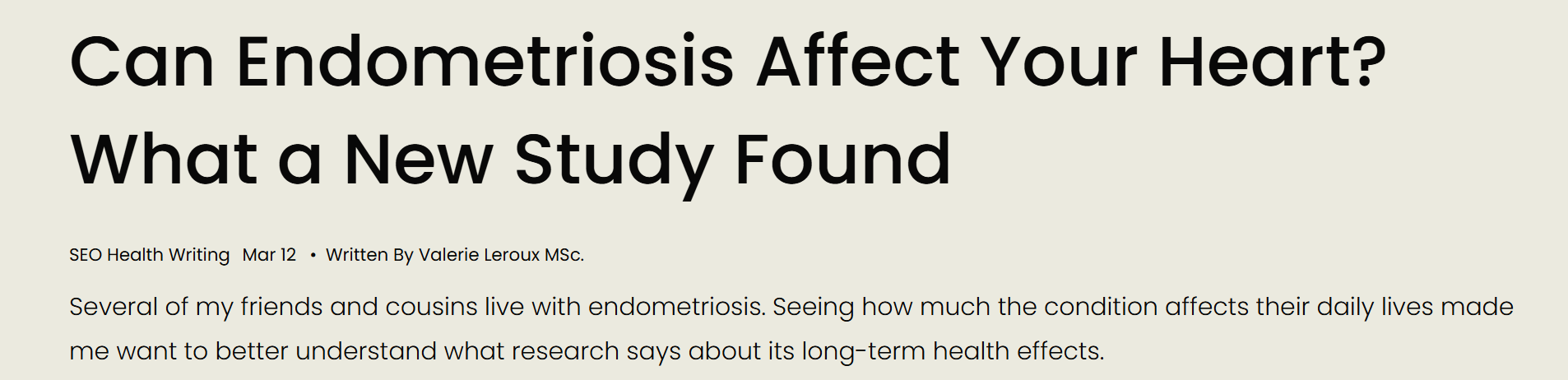
Example of a research paper turned into an SEO-friendly blog post
Here’s how I approached it:
A clear, relevant introduction
I started by grounding the topic in real life. Endometriosis affects many women, which immediately helps readers understand why the research matters.
A quick summary (TL;DR)
I highlighted the key findings early on in a few bullet points. This helps readers quickly grasp the main message, especially those who are scanning.
Plain-English explanations
I translated concepts like inflammation and hormone changes into simple, accessible language so readers can follow along easily.Context and interpretation
I explained what the results mean in practice. This includes clarifying concepts like relative risk to support accurate understanding.Transparent limitations
I included the study’s limitations to support balanced interpretation and strengthen trust.A patient-friendly, empathetic tone
This is something I prioritise in every piece. After more than 10 years in healthcare marketing and editing work from over 100 medical writers, I’ve seen how tone directly shapes trust and engagement.
The result is a piece of content that stays faithful to the science while remaining accessible and reassuring for readers.
What a Medical Writer Actually Does (Step-by-Step Process)
When you hire a medical writer to turn research into a blog post, you’re paying for more than writing. You’re paying for a process that turns complex research into clear, trustworthy content your audience can understand and use.
Here’s what my 9-step process looks like:
Step 1 — Identify Search Intent and Reader Needs
Every strong piece of content starts here, before a single sentence is written. I first define the audience and what they’re actually looking for when they search for this topic.
This is where human search intent comes in. Understanding whether someone is looking for information, reassurance, or guidance shapes how the content is structured and explained.
Identifying the keyword at this stage also gives valuable insight into how a lay audience thinks and searches. In my example, the keyword was “can endometriosis affect heart health,” which reflects how people naturally phrase their concerns.
That wording reveals both the language and the intent behind the search. The reader is likely looking for a clear answer, simple explanations, and reassurance about their health.
I also review what’s already ranking on Google to understand what readers expect and where content falls short. This helps shape a piece that is both more helpful and more aligned with SEO.
Step 2 — Front-Load Key Findings
Research papers build slowly and present the main findings toward the end. Blog content follows a different approach. Readers expect a clear answer upfront, especially when it comes to health topics. This means leading with the main takeaway first, then adding detail and context.
In my endometriosis example, I introduced the key insight early in the introduction. I wrote that the meta-analysis “suggests there may be a small increase in the risk of certain heart and blood vessel diseases,” which directly answers the reader’s core question.
I then reinforced this with a dedicated TL;DR section placed right after the intro. This section highlights the key findings in bullet points, including [1]:
Stroke: about 18% higher risk
Coronary heart disease: about 36% higher risk
Overall cardiovascular disease: about 16% higher risk

Example of TL;DR summarizing key findings from a research paper [1]
This structure makes the content easy to scan and helps readers quickly understand the main message. It also reflects how people read online, especially when they are looking for clear, reliable answers.
Front-loading key findings also supports SEO and AI visibility. Clear, structured answers are more likely to be picked up in featured snippets and AI summaries, which increases the reach of the content.
Step 3 — Remove or Simplify Methodology
Research papers include a lot of detail about how the study was done. This is important for scientists, but it can feel overwhelming for most readers.
In a blog post, the goal is different. You want readers to understand the key message quickly and feel confident in the information. This means keeping only what helps understanding and trust. Anything too technical or detailed can be simplified or removed.
In my endometriosis article, I explained the method in simple terms. I wrote that researchers “looked at results from several studies” thanks to a meta-analysis.
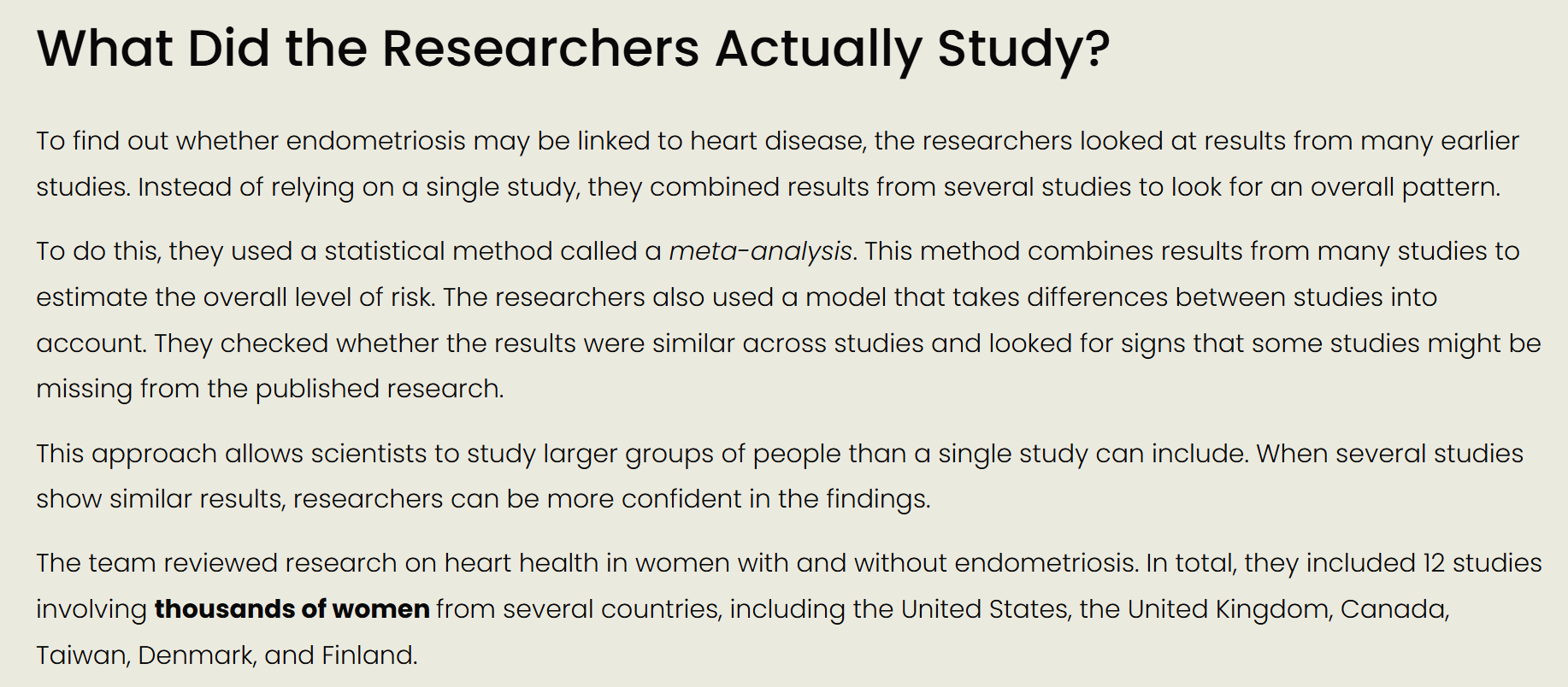
Example of methodology explained in simple terms
I then explained what that means in plain English. I said it combines results from several studies to give a clearer overall picture. This gives readers enough context to trust the findings. It also helps them understand where the numbers come from.
I did not include technical details like statistical models or study selection criteria. These details are useful for researchers, but they do not help most readers.
Step 4 — Translate Findings Into Plain English
In my endometriosis article, I translated key concepts and medical terms into simple language. For example, I explained inflammation as part of the body’s defense system that can cause damage when it lasts too long.

Example of how chronic inflammation can be explained in plain language
This approach helps readers follow along without feeling overwhelmed. It also builds trust, because they understand what they are reading.
I avoided jargon and complex phrasing wherever possible. Instead of using dense scientific language, I used short sentences and everyday words.
At the same time, I kept the meaning accurate. For example, I clarified that the study shows a “higher risk,” not that these conditions will happen.
Step 5 — Explain the “So What” (Context + Mechanisms)
Research findings on their own are not enough. Readers want to understand what the results mean and why they matter. This is where you explain the “so what.” You connect the findings to how the body works and what it could mean in real life.
In my endometriosis article, after sharing the increased risks, I explained why this link might exist.
For example, I described how long-term inflammation can damage blood vessels over time. I also explained how hormone changes, especially involving estrogen, may affect heart health.
I added other related factors to give a fuller picture. These included high blood pressure, cholesterol levels, and early menopause, which are all linked to cardiovascular risk.
This helps readers understand that the condition may affect more than one part of the body. It also makes the research feel more relevant and easier to grasp.
I then connected this to real life in a simple way. I explained that this research may encourage doctors to monitor heart health more closely over time.
This step turns data into meaning. It helps readers understand why this study matters to them.

Example of “so what” explaining what’s in it for the readers based on the original research paper
Step 6 — Interpret Risk Responsibly
This is where strong medical writing stands out. Besides reporting numbers, your blog should explain them in a way that is accurate and responsible.
In my endometriosis article, I clearly stated that the results show a relative increase in risk. For example, an 18% higher risk of stroke does not mean most women will experience it.
I added context to help readers interpret these numbers correctly. I explained that these conditions remain uncommon, especially in younger women.
This step avoids unnecessary fear. It also builds trust by showing a balanced and honest interpretation of the data.
Step 7 — Add Credible Sources and Transparency (EEAT)
In my endometriosis article, I cited all key sources clearly. This included the original meta-analysis and supporting studies from trusted organizations. This makes it easy for readers to trace the information. The original study is clearly referenced, so readers can explore it further if they wish.
I also included a dedicated section on study limitations. This helps readers understand how strong the evidence is and how to interpret the findings.
Finally, I reinforced credibility through my author bio. I highlighted my background in biomedical engineering, healthcare marketing, and SEO health writing.
These elements work together to build trust. They show that the content is accurate, transparent, and written by someone qualified to interpret the research.
Step 8 — Structure for Readability and SEO
Structure plays a key role in how content is read and ranked. Clear formatting helps readers scan the page and find answers quickly.
In my endometriosis article, I used descriptive subheadings to guide the reader through the content. Each section answers a specific question, which also supports SEO.
I kept paragraphs short and focused. This improves readability, especially on mobile, and makes the content easier to follow.
I also added visuals to support understanding. For example, I included an infographic to explain how endometriosis may affect heart health.
This structure makes the content easier to read and more engaging. It also helps search engines understand and surface the content more effectively.
Step 9 — End With Clear Takeaways

Example of a clear takeaway from my research-based blog post about endometriosis
A strong ending helps readers understand what matters most. It brings the key points together in a simple and useful way.
In my endometriosis article, I summarized the main insight clearly. I explained that the condition may affect overall health, including the heart, and that research is still evolving. I then connected this to practical next steps. I highlighted the value of regular check-ups and monitoring common risk factors like blood pressure and cholesterol. This gives readers a clear takeaway they can act on. It also leaves them with a sense of clarity and direction.
What Happens When This Is Done Poorly
These are the most common issues I see in blog posts that summarize research. They directly impact SEO, conversions, and brand trust.
AI-generated summaries with inaccuracies
These often oversimplify or misinterpret findings. In health content, small nuances matter and can change the meaning.AI content “fixed” as an afterthought
Editing wording does not solve deeper issues. If the structure, intent, and interpretation are weak, the content still lacks value.Generic blogs with no added insight
These repeat what already exists online. This makes it harder to rank and positions the brand as interchangeable.Overly academic tone
Dense language reduces clarity and engagement. Readers struggle to connect with the content and leave quickly.Poor risk communication
Numbers are shared without context or reassurance. This creates confusion and can raise unnecessary concern.
These issues compound quickly. The result is content that struggles to rank, fails to convert, and weakens brand authority.
Why This Matters for SEO and AI Search
Search engines and AI tools prioritize content that is clear, structured, and trustworthy. This is where strong medical writing directly impacts visibility.
EEAT (Experience, Expertise, Authority, Trust)
Content backed by credible sources, clear explanations, and expert interpretation signals quality. This is especially important for health topics.Helpful content updates
Google favors content that genuinely helps users. Clear answers, simple language, and well-structured sections improve engagement and rankings.AI citations and summaries
AI tools pull from content that is easy to understand and well-organized. Clear takeaways, structured sections, and accurate explanations increase the chances of being cited.
Final Thoughts: How to Improve Research-Based Blog Content (Quick Wins You Can Apply Today)
Here are a few focused changes to improve how you turn research into SEO-friendly blog posts for a lay audience:
Start with your main takeaway. Write it in one clear sentence, then build your introduction around it so readers immediately understand the value of the content.
Next, simplify one section at a time. Replace one technical term with plain language or add a short explanation where needed to make the content easier to follow.
Then, check how your content reads outside your field. Ask someone you know who doesn’t have a medical or scientific background to read your content. This helps ensure your content connects with a broader audience.
Two ways I can support you:
1. As a health and medical writer specialized in SEO health blogs, I can help you turn research into patient-friendly blog content that ranks and builds trust. Get in touch to discuss your project, and we’ll get started.
2. If you have an in-house team or you're a medical writer, I run workshops and a mentorship program on SEO health writing.
Frequently Asked Questions About Turning Research Into Blog Content
-
From my experience working with health brands and editing content from over 100 medical writers, the biggest shift is structure. You move away from academic writing and focus on clarity and usefulness for the reader.
I start by answering the main question right away. People skim read online, so I keep sentences short and use simple language.
I focus on key findings and remove unnecessary details. Then I explain what the results mean in real life so readers can understand and use the information.
-
An academic blog is written for peers. It often includes technical language, detailed methods, and in-depth analysis.
A patient-focused blog is written for a general audience. It explains research in plain English and focuses on what the findings mean in real life. Here is an example of an SEO-friendly, patient-focused blog.
-
From my experience, the key is understanding the research first, before trying to simplify it. Otherwise, it’s easy to misinterpret or oversimplify important details.
I start by identifying the few findings that actually answer the reader’s question. Most papers include a lot of information, but only a small part is useful for a blog post.
Then I translate those findings into plain English. I explain terms clearly and add context so readers understand what the results really mean. I also pay attention to how results are presented. For example, I clarify relative risk and avoid overinterpreting findings, which helps keep the content accurate and trustworthy.
-
Yes, but only at a high level. The goal is to build trust without overwhelming the reader.
For example, in my endometriosis article, I briefly explained that researchers reviewed several studies and used a meta-analysis. I also added a short explanation of what that means so readers could understand the source of the findings.
I kept this section concise and focused on clarity. I left out detailed methods, statistical models, and selection criteria, as they do not add value for a general audience.
-
Linking to the original study improves transparency and credibility. It shows where the information comes from and allows readers to explore the source if they want more detail.
For example, in my endometriosis article, I linked directly to the meta-analysis so readers can trace the findings back to the original research. This helps build trust and supports SEO by reinforcing source quality.
I also included additional studies referenced in the paper. In this case, it was a requirement from the publication process, but it also strengthens the content by showing a broader evidence base.
Overall, linking to sources benefits both readers and search engines.
-
Most research-based blog posts fall between 800 and 1,500 words. This range usually allows enough space to explain the findings clearly without overwhelming the reader.
That said, length depends on how much explanation the topic needs for the information to be helpful and relevant. That’s why I focus on depth over word count.
-
In practice, AI often misses important elements such as accurate interpretation and context.
For example, in health content, AI may present relative risk without context or simplify findings in a way that changes the meaning.
From what I’ve seen editing research-based blogs, fixing them often requires reworking the structure and interpretation, beyond wording edits.
References
Cavadias I, Maitrot-Mantelet L, Perol S, et al. Risk of cardiovascular disease and mortality among women with endometriosis: A systematic review and meta-analysis. Acta Obstet Gynecol Scand. 2026;105(2):225-237. doi:10.1111/aogs.70104
Share this article:




About the Author
Valérie Leroux, MSc, is a bilingual SEO health writer and founder of Bioty Healthcare since 2022, helping health brands and medical writers create high-ranking, trustworthy content backed by science and empathy.