
SEO Case Study: How a Multilingual Health e-commerce Strategy Drove 6.4M Impressions and Recovered Organic Visibility
I started working with Oravix, a health e-commerce brand specializing in oral health products, in 2024. This project is still ongoing as of 2026. When the collaboration started, several blog articles were already live, mostly aimed at the French market. However, they had not been developed within a structured SEO strategy, and the blog had been inactive for some time.
Over the following 16 months, rankings were stabilized, high-value assets were strengthened, a structured US expansion roadmap was implemented, and content was scaled strategically across markets.
Below, you’ll see the before-and-after transformation. Then I’ll show you what happened to get there.
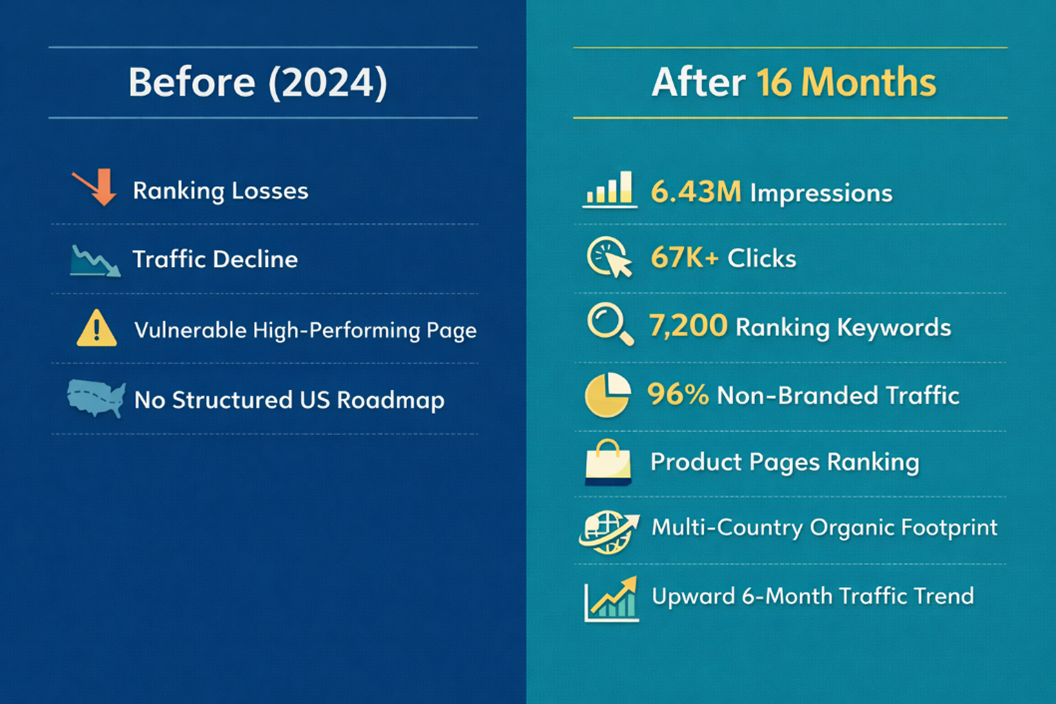
Before and after results (over 16 months)
The starting point: organic visibility loss
When I began working with Oravix, the site already had some organic visibility in the French market.
Several educational blog posts were driving traffic. One flagship article, in particular, ranked consistently in the top results and generated most of the organic clicks. The products were strong, and there was clear search demand around oral health topics.
At the same time, I had already started optimizing key French pages. I refined the structure, improved headings, clarified search intent, and strengthened on-page signals. As a result, some newly optimized pages began to gain traction.
However, despite these early improvements, the overall growth was fragile.
Blog posts existed, but they had not been created as part of a clear SEO strategy. There was no structured content cluster architecture to build topical authority.
A deeper content performance audit I conducted in 2024 revealed where the real risk was.
Semrush data showed ranking declines across both desktop and mobile. Most importantly, the site’s highest-performing article had dropped out of the Top 3 results for a core, high-intent keyword. That same page represented the largest click loss over the previous six months.
Google Search Console confirmed the pattern: rankings were slipping.
At that point, it became clear the site needed structure, stability, and a long-term plan.

Mission Objectives:
The mission focused on:
- Stabilizing and recovering declining organic visibility
- Strengthening high-performing pages before publishing new content
- Reinforcing rankings for key educational assets
- Building structured topical authority in the US market
- Aligning informational content with product intent
- Strategically connecting blog content to product pages
The Results: strengthened authority across markets and pages
Over time, impressions and traffic started to recover.
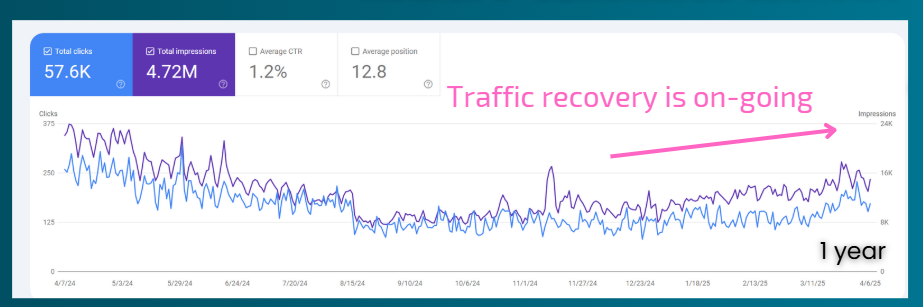
SEO performance trend over 12 months (Source: Google Search Console July 2024- June 2025)
Over the next 16 months, the site generated 6.43 million impressions and more than 67,000 organic clicks, with an average ranking position of around 12. Instead of relying on one flagship article, multiple URLs began ranking in the Top 10. Visibility became distributed across the site.
Both blog posts and product pages appeared consistently in search results. Organic traffic was no longer limited to educational content alone. Commercial pages began ranking independently, increasing product discoverability directly from search.
Informational content played a central role in this growth. Blog articles were strategically connected to relevant product pages through internal linking, creating clear pathways from learning to purchasing.
Independent tracking through Semrush confirmed this expansion. The site grew to rank for more than 7,200 keywords, with increasing visibility. More than 96% of traffic was non-branded, indicating that growth was driven by new discovery rather than existing brand searches. Approximately 80% of keyword intent was informational, building awareness that supported commercial queries further down the funnel.
The site also gained presence across enhanced search results and early AI-generated search experiences, reinforcing structural clarity and topical authority.
Geographically, organic visibility expanded beyond a single market. The United States began contributing to traffic more significantly. This was supported by a structured multilingual rollout. The impact was recognized internally by Oravix leadership:
“If you need top-notch content and a solid SEO strategy, Valérie is the go-to expert.”
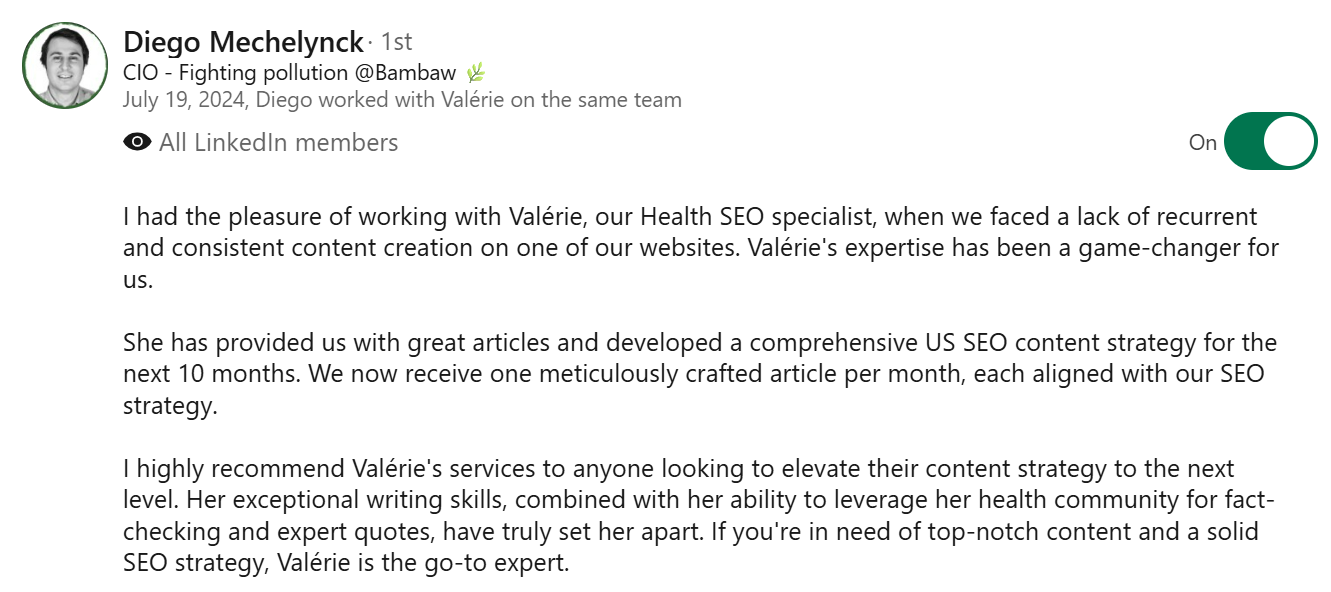
The Process: What I Did to Get There
Phase 1: Strategic Content Optimization (Traffic Recovery, late 2024)
I started by protecting what was already working and by optimizing existing pages, including the top-performing one.
Here’s what I did:
Re-aligned keywords to match search intent
Improved structure with clearer H1, H2, and H3 headings
Reorganized sections to answer user questions more directly
Added FAQ sections targeting related queries
Inserted medical disclaimers for compliance and trust
Added expert quotes to reinforce credibility
Strengthened internal links to relevant product and blog pages
Improved on-page clarity to support crawl signals
An example of this optimization included adding expert quotes from trusted health professionals in the dental field directly into the article. This strengthened medical positioning and improved EEAT signals, especially important in health-related search queries.
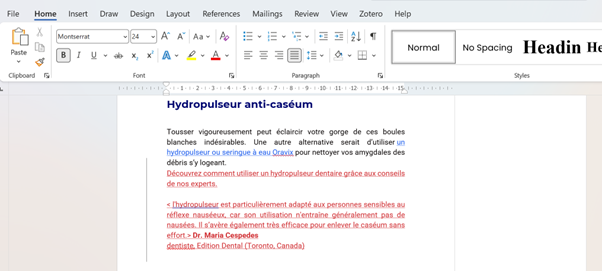
Example of optimization – how I added expert quotes to a top-performing page (French blog)
As a result, visibility started to recover.
Phase 2: US Expansion & Product-Led Strategy (Late 2024 and 2025)
Once rankings stabilized in France, it was time to grow.
The next step was expanding into the US market with a clear plan. I developed a 10-month roadmap built around one blog post per month and focusing on a specific product. Each article was carefully selected to match commercial opportunities and product relevance.
The next step was to build deeper authority around one core oral health theme.
We mapped out a content framework of more than 30 related blog topics as part of this pillar (this strategy work was done by collaborating with another freelancer, as I didn’t have capacity at the time). I then started to write.
In 2025, eight of these articles were published, each selected strategically based on priority and impact. I also contributed to commissioning graphics and videos to support this plan based on insights from my research. This project was coordinated by the website manager and involved other internal team members and freelancers, such as a graphic designer.
Every piece of content served a clear role:
Address a specific search question
Strengthen topical depth
Connect naturally to relevant product pages
Support product rankings through internal linking
This created a smooth bridge between informational searches and commercial discovery.
Phase 3: Multilingual Scaling
I then searched for keywords in French, translated, and adapted each article for French readers. At the same time, the team extended the rollout from US English to other European languages. This work is still ongoing as new articles continue to be published and localized.
I kept the same structure, internal linking system, and alignment with product intent across languages. I adjusted wording and examples to reflect local nuance, but I maintained the strategic foundation.
Lessons From This Project
This project reinforced several important principles about health e-commerce SEO.
Structure matters more than volume.
Besides publishing frequently, clear architecture, internal linking, and intent alignment drive long-term results.Traffic drops require precise updates.
When rankings decline, strengthening high-value pages often delivers stronger results than rushing new content.Product pages can rank when supported by aligned content.
Educational articles create authority. Strategic internal linking helps search engines connect that authority to commercial pages.
If I wanted to optimize further for the French market, I would likely conduct a separate, in-depth keyword strategy specifically for the French market rather than adapting from the US framework. I would also invest more time in sourcing additional local experts and local scientific references to further strengthen authority signals.
If you run a health e-Commerce brand and want similar results, there are several ways we can work together.
I offer:
SEO health content writing services
Strategic content roadmaps for health e-commerce brands
Workshops for in-house marketing teams
👉 Get in touch to talk through what would fit your situation best.
Val ✍🏼
FAQ: Health E-Commerce SEO Content Strategy
-
Not necessarily. Product pages can rank on their own, but in a competitive sector, they may perform much better when supported by aligned educational content. Informational articles help build topical authority and guide search engines toward your commercial pages through internal linking. In this case study, structured blog content strengthened product visibility and reduced reliance on paid ads.
-
SEO is cumulative. In this project, stabilization began within months after optimizing key pages. Broader visibility growth developed steadily over 16 months (with one blog per month). Recovery can happen relatively quickly when focused on high-value assets, while expansion requires consistent execution over time.
-
Not always. Auditing existing pages (including product pages) is often helpful to make sure you optimize your chances of getting results from your SEO efforts and identify priorities and quick wins. Traffic declines often require targeted updates to high-performing pages rather than rushing new content. Strengthening structure, search intent alignment, and internal linking can restore momentum more effectively than increasing volume.
-
Yes, when built on a strong strategy. Expanding into additional languages works best after strengthening the structure and positioning in a primary market, as was done in this case study. That said, I believe the strongest approach is to develop a dedicated local keyword strategy for each strategically interesting market. This allows you to adapt to cultural nuance, local search behavior, and competition.
-
Yes, I’ve seen health e-commerce brands compete without a large SEO team when they focus on quality content and consistency in their niche.
In this project, growth came from steady, strategic work focused on building niche authority. By aligning content with specific search intent and connecting it clearly to products, the brand gained visibility for targeted queries.
-
Yes, organic visibility can grow even in competitive health markets.
However, competitive niches require focus. Established brands may already dominate broad keywords, so trying to compete everywhere at once rarely works.
This is where the 80/20 rule in SEO becomes powerful. Often, 20% of your pages drive 80% of your results. Instead of spreading efforts thin, a strategic approach identifies the high-impact pages and queries that can move the needle fastest. That’s what an initial audit by an SEO expert can help you identify.
Share this article:




About the Author
Valérie Leroux, MSc, is a bilingual SEO health writer and founder of Bioty Healthcare since 2022, helping health brands and medical writers create high-ranking, trustworthy content backed by science and empathy.

See how a health e-commerce brand recovered rankings and scaled with a multilingual SEO strategy, reaching 6.4M impressions and US market growth.