
What to Post on LinkedIn as a Medical Writer If You Want to Be Taken Seriously
Let’s start with the real question most people don’t say out loud: How do I post on LinkedIn without looking stupid?
If you’re a health or medical writer, that fear is very real as our content directly reflects our writing abilities. You might be thinking:
“Everyone else sounds more experienced.”
“What if I say something wrong?”
“What if I only get two likes?”
“What if clients see this and think I’m not good enough?”
I know that feeling well. I spent over 10 years working in the healthcare corporate world before specializing in SEO health writing in 2022 as a freelancer. Since then, I’ve posted consistently on LinkedIn, nearly 5 times a week for 3 years (over 700 posts). I started posting so that I can rely less on outreach someday. Today, most of my clients come through referrals or directly from LinkedIn.
When I first began freelancing, I didn’t know what my offer was going to be, so I didn’t really know what to share. I also thought my posts wouldn’t be any different compared to what was already shared online. Over time, I realized something important: in freelancing, how you think matters more than how many likes you get, and it’s your own perspective on existing topics that brings value.
In this guide, I’ll walk you through:
What to post on LinkedIn as a medical writer
What not to do on LinkedIn posts (common LinkedIn post mistakes to avoid)
And how to build credibility in a way that feels professional with a simple content strategy
If you’ve been trying to post but you’re overthinking every word (hello imposter syndrome), this is for you.
Full disclaimer: this strategy to acquire new clients does take time and requires consistency. If you’re struggling right now and need clients quickly, you should read this post instead: how to survive as a freelance writer.
Why LinkedIn Matters for Medical Writers (Beyond Engagement)
1. It attracts inbound leads (even if it often comes from silent readers)
As a health or medical writer, I’ve learned that it’s far more useful to stop counting likes and start viewing LinkedIn (and all of my marketing content, for that matter) as part of my professional reputation. In fact, the posts that lead to real business are often the ones with little to no engagement. The people who reach out to me are usually silent lurkers. I’ve never seen their names before. But when they message me, they already trust me. I’d say they’re at least 80% there.
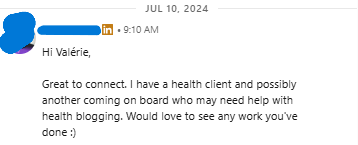
Example of inbound lead via LinkedIn
At that point, I’m not competing with other writers. They want to see if they can work with me. The only real filter left is budget.
2. Your Digital Footprint Is Part of Your Reputation
When you apply for a job or reach out to a client, they will often:
Look at your LinkedIn profile
Check your website
Google your name
Read a few of your posts
They’ll ask themselves: Does this person sound trustworthy?
And in health writing, trust matters more than anything. And I’m sure you’ve heard how much harder it is to gain people’s trust (and I can confirm! I’ve seen the difference even in the last 3 years).
You should see from this that your LinkedIn posts become part of your digital footprint. They show how you think. What standards you follow. What topics you care about. Over time, that visibility starts to build your credibility.
3. Credibility Builds Slowly (And That’s Normal)
I want to be honest with you. This is a long game, and it feels even longer when you’re creating all of this content for what seems like a few likes and little return at first. But people need time to:
See your name more than once
Read a few of your posts
Notice that you’re consistent and thoughtful
One post won’t change much. Ten posts might not either. Especially since this is short-form content (you have about 500 words), it’s harder to demonstrate much depth and expertise in one post. You’ll also need to keep building your network of connections over time for your posts to get seen by the right people.
When I started in 2022, I posted twice a week. After about six months and once I was clearer on my niche, I increased to 5 times a week. I didn’t start getting steady leads until about a year later.
Your rhythm might look different. Maybe it’s once a week. Maybe it’s twice a month. That’s fine. What matters most is that you keep showing up.
4. LinkedIn Supports Your Visibility in Google and AI Search
There’s another reason this matters, and I learned this by doing SEO. Google indexes some LinkedIn posts and profiles. LinkedIn is a trusted platform, so your posts can appear in search results, especially when someone searches your name or a topic you’ve written about.
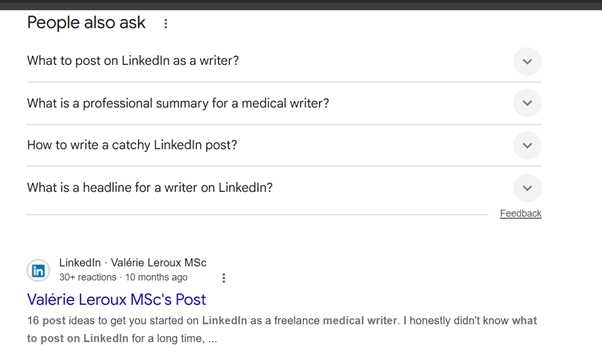
Example of one of my LinkedIn posts ranking on Google.
AI tools like ChatGPT or Perplexity can also surface LinkedIn content when it clearly answers a question. Posts that are structured, specific, and sometimes include references are more likely to be picked up. In other words, I follow the same SEO standards and EEAT guidelines (Experience, Expertise, Authority, and Trustworthiness) I use in my health blogs.
And when you’re doing SEO work for clients, your own visible expertise on social media can reinforce your authority as an author. It contributes to your professional trust signals (just like bylines do).
And again, credibility is cumulative: you need both quality content and volume (thanks to consistency over time) to make it work.
What to Post on LinkedIn as a Medical Writer
When medical writers ask me what they should post on LinkedIn, they usually want a list. I’ll give you ideas for inspiration, but what matters more is why you’re posting and how that content builds your credibility over time.
After nearly three years of posting (almost daily at times), even though I don’t follow any content strategy myself, I reflected and analyzed patterns from my content to give you a simple framework you can follow if you don’t know where to start. I’ve noticed my content falls into 3 main categories. Each one builds trust in a different way.
1. Educational Posts (Expertise in your niche)- a majority of my content
If you can explain complex health topics simply (or SEO topics in my case, as it’s my niche), clients assume you can do the same for them. These posts might not get the most engagement, but they build authority quietly. They show not only what you know, but how you communicate in your writing.
Ideas you can try:
Explain a medical term in simple words.
Break down a new research study.
React thoughtfully to a health news story.
Explain something you recently studied.
Clarify a common misconception in your niche.
Examples from my own LinkedIn:
In this post, I reacted to a Guardian article about misleading health advice appearing in AI search summaries (Google’s AI Overviews). Instead of paraphrasing the news, I explained why it matters: AI systems pull from existing online content, which means the quality of top-ranking health blogs directly impacts what patients see. I clearly mentioned the source as I do in my health blogs.
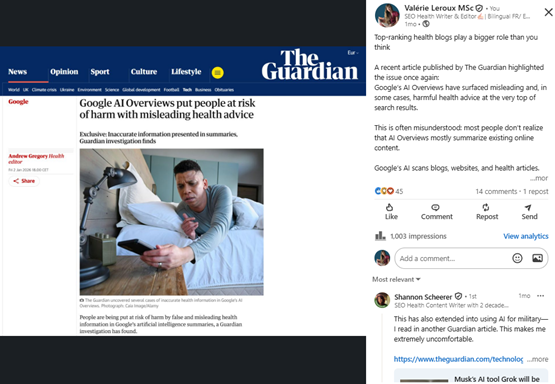
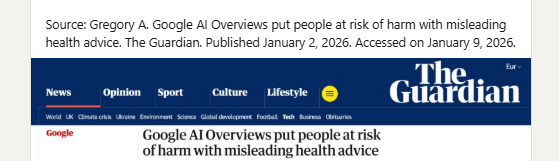
Example of an educational post: Reacting to health misinformation in AI search (with mention of my source of information). Source: LinkedIn post (January 2026).
2. Experience & Results-Based Insights from Client or Previous Work
If educational posts show your expertise, experience-based posts show your judgment. Judgment matters just as much as knowledge (if not more in the age of AI!).
I don’t share confidential client details (obviously), but I regularly share what I’ve learned from working on real projects, and those posts tend to resonate. That’s also much harder to fake. Sharing results from my work helps warm leads take action, so these are very important as well, but they only represent a small portion of my content.
I like to use deeper personal topics too, but you don’t have to if it feels uncomfortable.
Ideas you can try:
What you learned from a recent project
A mistake you fixed (without blaming anyone)
Your best experience with a client — or your dream project
The impact of being sick while freelancing
What you worked on today and what it taught you
Five reasons you chose freelance work
Your career path so far
Behind-the-scenes of how you work
Case studies (even small ones) and testimonials
Before & after improvements
Examples from my LinkedIn:
Sharing practical tips and best practices. In my “Friday Val’s SEO Tips” posts, I often explain SEO-related things like why adding credible sources changes how your content is perceived. Those posts are quite useful to writers but also demonstrate experience and expertise in my niche.
Explaining what happens inside my 5-day writing challenge
Announcing client wins
Sharing how one of my blogs ranked
Explaining my experience in ghostwriting
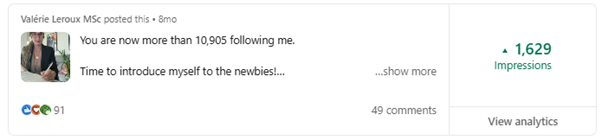
Simply introducing myself – my story, my background, my journey, and where I’m at now. Those are always doing well, and I think they’re important for your new followers to get to know you. I post them every 1-2 months with a twist.
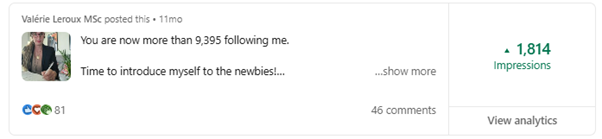
Examples of top-performing posts: Simple introductions with my key career milestones
Here’s another example, a post describing an SEO collaboration with a fellow writer, with a growth chart showing Google impressions and clicks, with a link to the full case study.
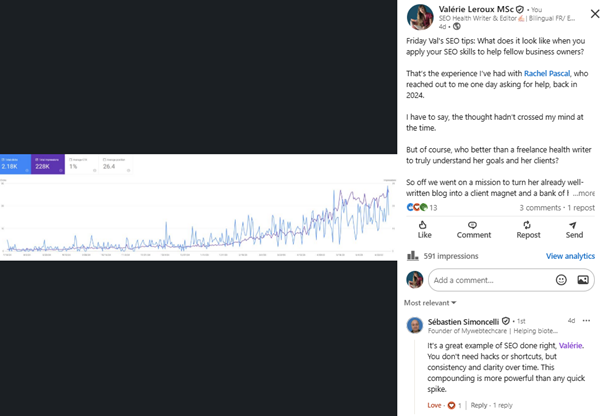
Example of a post sharing a case study from one of my SEO clients in my “Friday Val’s SEO tips” on LinkedIn. Source: LinkedIn post (February 2026).
Below is another post showing real paid work I was hired to do. It also includes comments from others praising the work, which act as visible social proof. That helps show potential clients that my services are reliable and trusted by others :
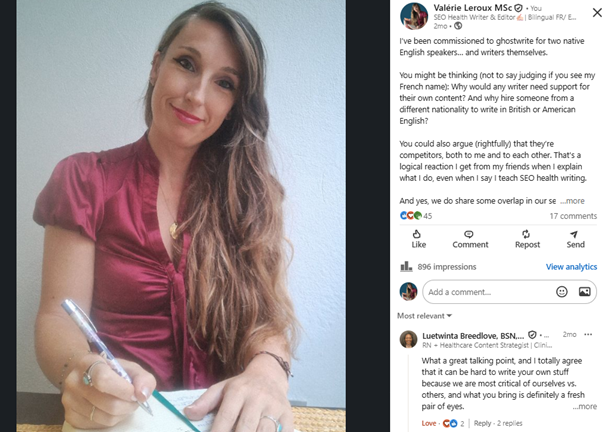
Example of an experience-sharing post. Source: LinkedIn post (November 2025)
3. Thoughtful Reflections on Freelancing or the Health Industry
I tend to reflect a lot on everything I do (I mean, that’s what I do all the time), so naturally, a lot of my content is me reflecting on things. I’m probably not sharing anything new, but some of my strongest conversations came from reflective posts because they really show the way I think. They show care, responsibility, and critical thinking, which reinforces my credibility.
Ideas you can try:
Talk about imposter syndrome.
Share how it felt to publish on LinkedIn for the first time.
Ask the community for advice.
Ask who inspires them and why.
Talk about freelancers who inspire you.
Share the health topics you’re passionate about.
Write about what you’d like to achieve by the end of the year.
Share a blog or book you loved.
Examples of topics I’ve shared:
Imposter syndrome and other reflections related to freelancing or owning a business
Managing unrealistic SEO expectations
Advantages of being multilingual in my work
Anecdotes taken from conversations or my hobbies, and how I relate them to what I do
Typically, when sharing freelancing-related topics, these posts get more engagement as freelancers tend to be more active on LinkedIn than our ideal clients. These shouldn’t your top priority, but they make a lot of sense for me though, as I’m a mentor to medical writers.
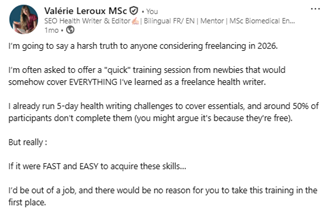
Example of a reflection about freelancing. Source: LinkedIn post (January 2026).
I also love to take a topic that’s not directly related to what I do, but draw a parallel with my professional life. This post about how I failed to climb Mont Blanc a few years ago is a good example:
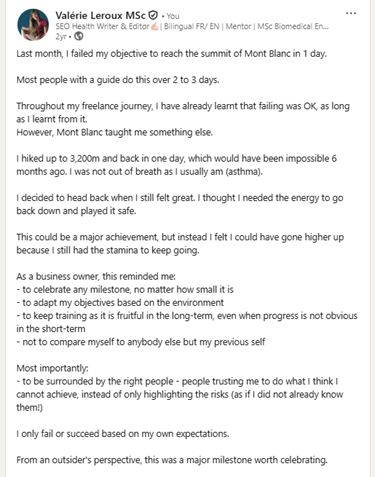
Example of a reflective post: a real failure story at Mont Blanc with business-relevant lessons about pacing, milestone framing, and the value of supportive peers. Source: LinkedIn post (September 2023).
My Strategic Tip: Use Search to Choose Relevant Topics
This is where my approach to LinkedIn is different. I don’t just post what comes to mind and what inspires me in the moment. I leverage my SEO skills: I sometimes choose topics that people are already searching for. Because if someone is typing a question into Google, that tells me something important: I have confirmation that there is demand for clarity on this topic, so I write more confidently as I know my post will be helpful, and I increase my chances of building my profile as an expert for search engines too.
Here’s the simple framework I use:
Identify a real question.
Write a short, structured answer.
Add a credible reference where relevant.
Include a natural call-to-action.
That’s it. That’s exactly what I do every day for my SEO health blog work and what I teach in my 5-day writing challenge.
What NOT to Post on LinkedIn as a Medical Writer
Many writers also ask me which posts could impact their reputation negatively. And since it takes forever to build a reputation but a fraction of a second to destroy it, that’s also something I try to be careful about, and this is my first priority in my freelance work.
If you’re in doubt after writing a post:
“Should I really say that?”
“Will this look unprofessional?”
“Am I oversharing?”
The answer is probably yes. Here are the types of posts I suggest avoiding (especially if you're just starting out) and what to try instead.
1. Vague Self-Promotion Without Context
If your posts are mostly saying “DM me for writing help” but without bringing any value as to why clients should hire you, it’s very unlikely your posts are going to do anything for you.
Instead: Share a real story behind a client project, or what you learned from a recent assignment, or your thoughts about a published article... anything to demonstrate your expertise to build trust. While it's definitely a good idea to have a CTA, don't expect too much at first (unless you already have a client network to activate and you’ve been publishing valuable content for a while).
2. Public Client Complaints or Emotional Rants
Freelancing has frustrating moments: late payments, unclear briefs, shifting deadlines… and “why do clients ghost?!”
Trust me, I hate how ghosting makes me feel too. But LinkedIn is not the place to vent, because even if you don’t name anyone, your current and future clients are watching.
Instead: Try to reframe these experiences as lessons learned. I’ve written about ghosting and delayed payments before, but not to blame anyone. Mostly to share what I learned, bearing in mind my lovely clients are watching (and they are honestly lovely, so I don’t want them to feel bad). I try to focus on what is within my control. Sometimes with a touch of humor, because that’s who I am in real life.
3. Forced Vulnerability for Engagement
You don’t owe vulnerability to get engagement. It took me a while to be more open on LinkedIn, and I never went viral. And that’s okay. You don’t have to share your personal traumas, health stories, or even your hobbies if you’re not ready for it and if it’s not culturally appropriate in your country.
Instead: Start with what you’re comfortable sharing, for instance:
Books you loved
Lessons from your work
Topics you’re passionate about
When (and if) you feel ready to share something more personal, do it because it feels safe and aligned. Not because you think it will “perform.” You can be human and show your personality without oversharing.
4. AI-Generated Posts Without Voice
Let’s be real here: we can all spot them. Remember that your value as a writer is what you can bring to content, and your own content in particular should be a reflection of yourself. There’s no point letting AI write for you, when the whole point is to bring your unique insights and experience to show why clients should hire you (and not rely on AI!). I know we have so much pressure because our content as writers or editors also reflects the way we work – but that’s also our biggest opportunity.
Instead: Use AI tools for support and proofread your posts if you want (I know I do), but edit like only YOU can. Let your voice lead and follow the same concepts you would in your health content (such as EEAT). Otherwise, you're honestly doing yourself a disservice as a writer.
5. Empty Listicles With No Insight
Lists like “Top 10 freelance tools” are easy to write and this is information people can get from AI or Google. What people want instead is to know what your personal experience of using those tools is.
Instead of listing 10 tools, explain:
How you used one tool
Why it helped
What changed because of it
What didn’t work
A Simple LinkedIn Strategy for Medical Writers
The pressure to sound polished can stop you from posting. I’ve felt it too. You might think, “I’ll post when I know more. When I feel confident. When it’s perfect.” But waiting for perfection only slows you down. Authority doesn’t grow from silence. It grows when you show up, again and again.
You don’t need to understand the algorithm. You don’t need to post every day. And you don’t have to share anything that feels uncomfortable.
If you’re new to freelancing and LinkedIn, here is a simple structure to inspire you to post once or twice a week:
| Week | Post 1 | Post 2 |
|---|---|---|
| Week 1 | Expertise: Answer a real health question in your niche | Experience: What you learned while researching or studying this topic |
| Week 2 | Expertise: Break down a study or explain a medical term simply | Reflection: Share insights on another freelancer’s post that inspired you (and tag them) |
| Week 3 | Expertise: Clarify a common misconception in your field | Experience: What you practiced or worked on this week (course, draft, editing, volunteering) |
| Week 4 | Expertise: Explain a health concept in simple language | Reflection: Your values, why you chose medical writing, or your career goals |
If you’ve been writing for a while and have already been publishing on LinkedIn, but you want to get inspiration to post more, here’s an example of a content plan with 5 posts per week:
| Week | Monday | Tuesday | Wednesday | Thursday | Friday |
|---|---|---|---|---|---|
| Week 1 | Expertise: Explain a concept in your niche (e.g., What is pharmacovigilance?) | Experience: Lesson from a recent project | Expertise: Break down a recent study in your field | Reflection: What you learned from a challenge you faced in medical writing | Expertise: Clarify a common misconception in your niche |
| Week 2 | Experience: How you structure a piece of writing (e.g., a patient education leaflet) | Expertise: Respond to a trending health news topic | Expertise: Define a medical term simply | Reflection: Boundaries in freelancing | Experience: Case study or client result |
| Week 3 | Expertise: Answer a common patient/professional question | Experience: What writing or editing a document taught you | Expertise: Compare two related medical concepts | Reflection: Ethical responsibility in health writing | Expertise: Regulatory or compliance insight |
| Week 4 | Experience: Career path or skill development lesson | Expertise: Break down a clinical guideline | Expertise: Explain a tool you use in your niche | Reflection: What you’ve been learning this year/week/month/quarter | Experience: Portfolio showcase |
Bonus tips:
I’m using Buffer as a free tool to program my content for the week ahead. This works well for me because I write posts when I feel like it during the week, and I know my content is secure even if I’m away, sick, or very busy the following week. I also note my ideas in there so that I never start from a blank canvas.
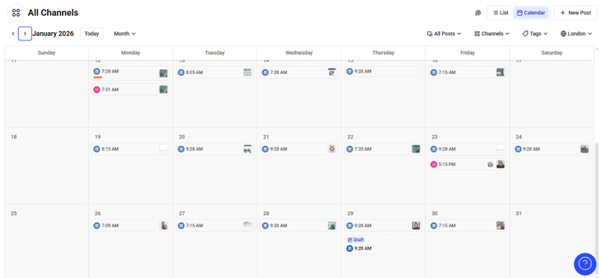
Overview of my Buffer content dashboard (January 2026)
It’s a good idea to build a commenting habit as well, using the same pillars. LinkedIn is a networking platform, and visibility grows faster when you combine posting with thoughtful comments. Commenting can also be a great starting point if publishing your own posts still feels overwhelming. You can engage for 5-10 minutes a day with posts from writers in your niche, potential clients, editors, content managers, or professional healthcare associations.
Final Tips: If You’re Still Wondering What to Post on LinkedIn as a Medical Writer
When you’re unsure what to post on LinkedIn as a writer, ask yourself:
Does this show my expertise in my niche?
Does this reflect my judgment or experience?
Does this communicate my values as a professional?
If the answer is yes, you’re on the right track.
If you’re wondering what not to post on LinkedIn:
Don’t rant about clients.
Don’t post vague “DM me” promotions.
Don’t copy AI output without adding your voice.
Don’t share something that doesn’t sound like you or that you’ll regret in a year.
And here’s something many writers still underestimate: having structured, evidence-informed public content under your own name increases the likelihood that your expertise is recognized and surfaced. Your LinkedIn posts are part of your searchable professional footprint.
If you want a step-by-step system to create one SEO-friendly LinkedIn post that builds credibility, I created a free 5-day writing challenge for health and medical writers.
Val ✍️
FAQs: Posting on LinkedIn as a Medical Writer
-
There is no magic number, but if you’re new to LinkedIn, it’s very likely that if you aim to post every day, you may not be able to stay consistent in the long run. It’s better to start small and build up experience over time. If you’re new, I’d say start with once or twice a week. That’s enough to build consistency without burning out. If you have more time and clarity in your niche, you can gradually increase.
What matters more than frequency is:
Showing up consistently
Posting content that reflects your expertise and how you think
Staying aligned with your professional standards
I personally started with two posts per week in 2022. After about six months, I increased to five per week. I only started seeing steady inbound leads after about a year. This is a long game.
-
If you’re a health or medical writer, avoid content that damages trust. This includes:
Public client complaints or emotional rants
Vague self-promotion with no context
AI-generated posts with no personal insight
Oversharing personal trauma for engagement
Listicles with no depth or explanation
If you're unsure what not to do on LinkedIn posts as a medical writer, start by protecting your credibility. Before publishing, ask: “Would I be comfortable if a future client read this?”, and if the answer is no, don’t post it.
-
Some of the most common LinkedIn post mistakes include:
Posting only when you have something to sell
Writing generic, AI-generated content
Trying to go viral instead of building credibility
Copying popular formats without adding expertise
Waiting until they feel “ready”
Not writing to their ideal clients due to lack of visible engagement
Some of my highest-converting posts had very little engagement. The right people were reading, they just weren’t commenting.
-
Even if you don’t have client work yet, you can:
Break down studies
Explain medical concepts
Reflect on what you’re learning
Share your career goals
Comment thoughtfully on others’ posts
-
AI can support you. It can help brainstorm ideas or improve structure. But to be credible, I think it’s important your LinkedIn content reflects your voice, your judgment, and your standards. If you rely entirely on AI, you remove the very thing that differentiates you: your thinking, the nuance, context, and professional responsibility you bring to health content.
-
I can’t say you need one as I didn’t have one myself, but I started freelancing with more than 10 years of experience in healthcare marketing so I kind of knew what I was supposed to communicate, and when I learned SEO health writing, I automatically applied the same concepts, such as EEAT, to my content. A simple structure might be enough to get you started:
Rotate between expertise, experience, and reflection.
Answer real questions in your niche.
Add a credible source when relevant.
Post consistently.
That alone will put you ahead of most writers.
-
Yes, but probably not in the way you think. Personal branding doesn’t have to mean sharing your private life or trying to be an influencer. For medical writers, personal branding simply means being consistent in how you demonstrate:
Your expertise
Your judgment
Your professional values
When someone reads several of your posts over time, they should start to recognize:
How you explain complex health topics
How careful you are with claims
What ethical standards you follow
What kind of projects you care about
That consistency is your brand. Besides your skillset, your posts should show how you think, your standards, and your critical thinking.
If your LinkedIn posts regularly show clarity, responsibility, and thoughtfulness, you are building a strong personal brand.
Disclaimer: The engagement metrics noted under my LinkedIn posts are snapshots from the public pages at the time of review, and can change later.



 Link copied!
Related resources
This blog post shows application of concepts presented in Building Trust & Authority with Health Blogs (E-E-A-T). This is a 90-minute, hands-on SEO workshop. It focuses on practical ways to spot and apply trust signals in health content, improve author credibility, and increase visibility in Google and AI systems. The live session includes simple exercises to complete after the workshop, with personal support by email.
About the Author
Valérie Leroux, MSc, is a bilingual SEO health writer and founder of Bioty Healthcare since 2022, helping health brands and medical writers create high-ranking, trustworthy content backed by science and empathy.

Compare the best medical writing courses by career goal (freelancing, SEO, pharma, patient education, CME, or academia) with real-world guidance and honest insights.