
What I Actually Do as an SEO Health Content Strategist in the Age of AI Search
Back in 2024, I applied for an SEO editor role for a US health app. As part of the hiring process, I received a task involving two blog pages that needed to be merged because they targeted the same topic. I also had to record a Loom video explaining my thinking as I created the content brief.
Before I touched the content, I checked whether the page they wanted to remove was actually the weaker one. I wanted to make sure the task itself made sense before I started working on it.
Later, they told me I was the only candidate who questioned this. I got the job.
Looking back, that moment says a lot about how I work. Even when clients hire me to write or edit content, I naturally step back and look at the bigger picture if I think it will lead to better results.
To me, that feels like common sense. If I'm working on your content, I want to understand whether it supports your goals before I start optimizing it.
Around the same time, I started mentoring medical writers and noticed something similar. I realized that I approached projects very differently from many writers (what we think is common sense is often not so common).
That is why I no longer see my work as simply "SEO health writing." Today, my work sits at the intersection of healthcare content, editorial strategy, SEO, audience psychology, and search behavior. My goal is always the same: to help you create content that is trustworthy, evidence-based, and genuinely helpful to the people reading it.
This article gives you a behind-the-scenes look at what that work actually involves.
Why Health Brands Need a Different Kind of SEO Content Strategist
Healthcare SEO helps the right people find reliable information while building trust in your brand at every step.
Healthcare is one of the most rewarding industries to write for. The content you publish can help people make important decisions about their health, understand complex conditions, or find the support they need.
That is why healthcare SEO sits inside what Google calls YMYL content: “Your Money or Your Life.” In other words, content that can directly impact someone’s health, safety, or well-being.
That responsibility comes with higher expectations: healthcare content needs to be medically accurate, compliant, evidence-based, and written with care. It often needs input from experts, patients, clear sources, and language that feels supportive and empathetic rather than alarming. It also requires a good understanding of the patient journey so you can provide the right information at the right time.
What I Actually Do as an SEO Health Content Strategist
Before making recommendations, I want to understand whether we are solving the right problem in the first place. Here's the six-step process I typically use to turn content into a long-term growth asset.
1. Understanding your business and audience
First, I want to understand your business. I need to know what services or products you offer, who you help, and what success looks like for your organization.
From there, I look at your audience. What questions do they have? What challenges are they trying to solve? What information do they need before they feel ready to book an appointment, enroll in a program, or make a purchase?
I also look at how you position yourself in the market. Understanding your competitors helps me identify opportunities to highlight what makes your brand different and why people should choose you over other options.
2. Auditing existing content
Some clients already have valuable content when they contact me. The challenge is that they do not always know where to start when it comes to becoming more visible and trusted to attract the right people.
This is why I start with a content audit. I review traffic, rankings, content quality, internal linking, and overall performance to understand where the biggest opportunities lie.
During this process, I often uncover missed opportunities where small updates could have a significant impact, rather than editing every single page.
For example, in a health e-commerce project, a content audit revealed that the site's highest-performing article had lost rankings for an important keyword. Rather than rushing to publish more content, I focused on improving that page first by clarifying search intent, strengthening structure, adding expert input, and improving internal links. Visibility began to recover, and the site went on to generate more than 6 million impressions over the next 16 months while expanding into new markets.
3. Building topical authority and content plans
I focus on building topical authority around the subjects that matter most to your audience and your business. This starts with identifying the key topics your brand should own. From there, I organize content into clusters that help search engines and readers understand the depth of your expertise.
The result is a strategic content calendar that supports both visibility and growth. This initial plan remains flexible: I typically finetune it over time as we gain clarity on what’s working and what’s not.

Diego Mechelynck
“Valérie has provided us with great articles and developed a comprehensive US SEO content strategy for the next 10 months.”
4. Creating SEO briefs that writers can actually use
One of the biggest lessons I learned as an SEO editor is that a weak brief almost always leads to weak content. A good SEO brief explains which keywords to target, the human search intent behind the topic, the structure of the article, the questions readers need answered, and any useful insights I have gathered from you, your customers, or subject matter experts.
I include recommendations for internal links and clearly define the goal of the page, including the call to action. This helps writers understand not only what they need to write, but also how the content fits into the wider customer (or patient) journey.
I also review what competitors currently cover and identify opportunities to create something unique, as in more helpful and relevant. The goal is not to publish another version of what already exists, but to create content that better serves your audience and showcases your expertise.
5. Optimizing for both humans and AI retrieval
Today, content needs to work for readers, search engines, and AI systems that generate answers directly within search experiences.
This starts with a clear structure and simple language. Readers should be able to find answers quickly, while search engines and AI tools should be able to understand the topic.
I also focus on clear citations, trustworthy sources, and original insights, which help reinforce credibility while making the content easier for Google and AI systems to interpret and reference.
6. Reviewing performance and refining strategy
SEO is definitely not a one-time project. Search behavior changes, competitors publish new content, and healthcare information continues to evolve.
That is why I regularly review performance and look beyond rankings alone. I pay attention to engagement, conversions, enquiries, and the actions people take after reading the content. I also look for qualitative signals that reveal how well the content serves its audience.
Rachel Pascal is a freelance medical writer and one of my SEO mentoring clients. Together, we worked on transforming her blog to help her attract the type of clients she wanted to work with.
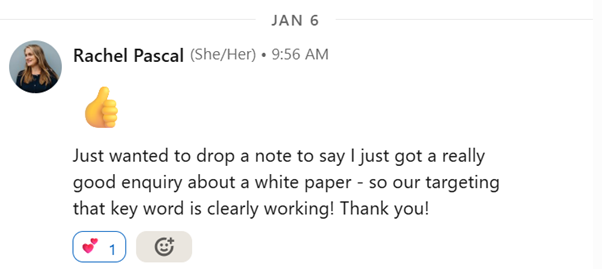
Testimonial from freelance medical writer Rachel Pascal
Common SEO Content Problems I See in Health Brands
One example that comes to mind is a CME medical education provider that approached me because they were concerned about their blog performance. At first glance, the content looked strong. The articles included detailed patient case studies, clinical insights from instructors, and clear evidence of expertise.
The problem was who the content attracted. Many of the topics and keywords brought in patients and members of the general public looking for health information. However, the business wanted to attract healthcare professionals interested in continuing medical education programs.
I’ve also seen health brands and non-profits creating content without thinking about the next step in the customer or patient journey. Readers may find the article, spend time engaging with it, and then leave because there is no clear path forward. Relevant calls to action, related resources, and logical links to services or programs are often missing or not visible enough.
I also often come across content that is medically accurate but difficult to read. Sometimes the language is too complex, the reading level is too high for a lay audience, or the content lacks the empathy needed to connect with readers.
Other brands rely too heavily on AI-generated content without enough expert input or editorial oversight. The content often lacks original insights, experience, and the trust signals needed in healthcare, which can’t be generated by AI.
What Health Brands Should Look for in an SEO Content Strategist
Health content comes with unique challenges, so it helps to work with someone who understands both SEO and the realities of healthcare communication.
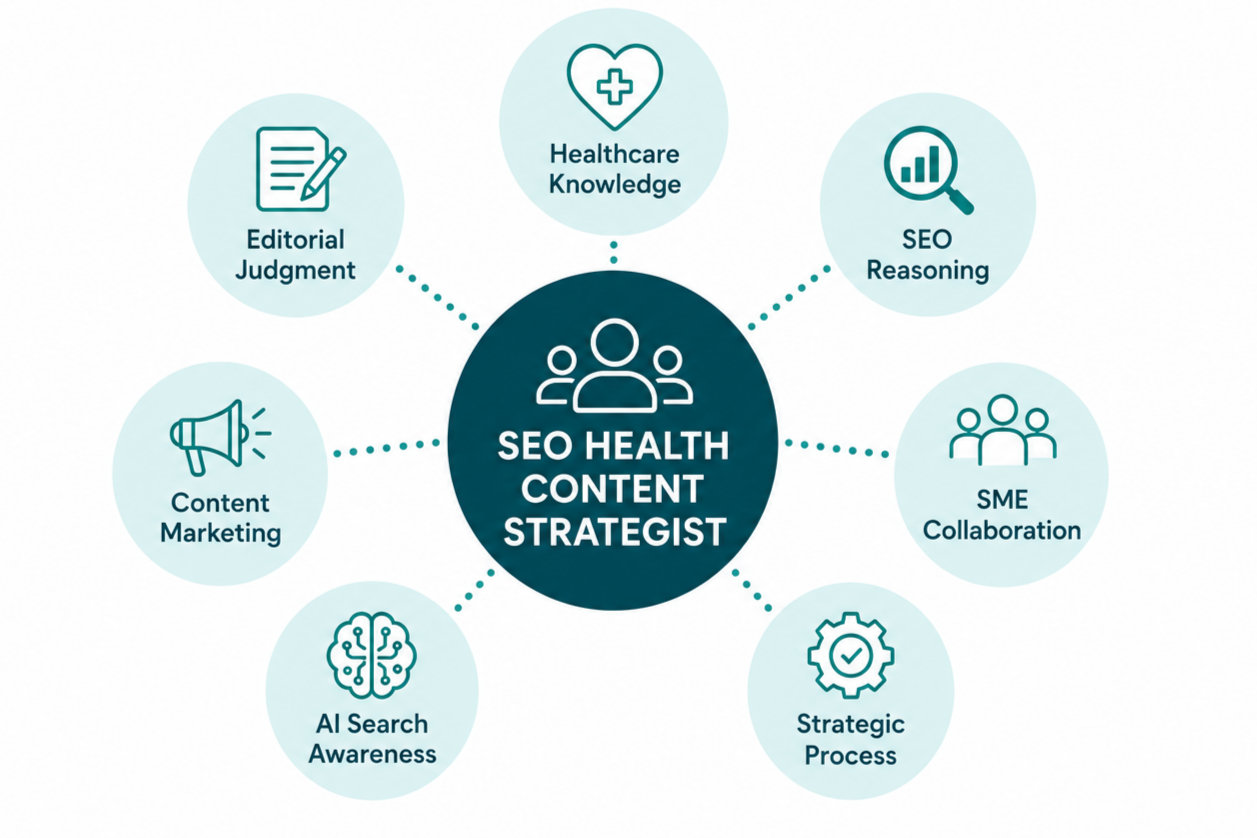
Key skills of an SEO health content strategist
First, look for someone with a solid understanding of healthcare. They do not need to be a clinician, but they should understand medical accuracy, health literacy, compliance considerations, and the importance of building trust with readers.
Editorial judgment is equally, if not more, important. A good strategist knows when to challenge assumptions, spot gaps in a content plan, and identify opportunities that others may miss. They should be able to look beyond keywords and think critically about whether a piece of content serves the right audience and supports the right business goals.
Strong SEO reasoning matters too. Anyone can follow a checklist, but a strategist should be able to explain why they recommend a particular approach and how it connects to your broader objectives.
It also helps to work with someone who understands content marketing as a whole. Your blog should not exist in isolation. A good strategist can identify opportunities to repurpose your content into newsletters, social media posts, lead magnets, patient resources, webinars, or sales enablement materials. This helps you get more value from the work you are already doing while keeping your messaging consistent across different channels.
Content is rarely created by one person alone, especially in healthcare. That's why it is important to work with someone who can collaborate effectively with subject matter experts, researchers, writers, patients and healthcare professionals.
They should also understand how search is evolving. Today, content needs to perform not only in traditional search results but also in AI-powered search experiences, where original insights play an increasingly important role, as everyone has access to the information provided by AI chatbots.
Last but not least, look for someone who thinks strategically and has a clear process. Successful content programs rely on more than individual articles. They need a system for researching topics, planning content, creating briefs, writing, optimizing, and making improvements over time. This helps ensure your content stays consistent, supports your business goals, and continues to deliver results long after it is published.
Why I Moved Into SEO Content Strategy
My career did not start in SEO. I spent more than a decade working in healthcare marketing before becoming a freelance health writer. During that time, I worked on product launches, marketing campaigns, customer journeys, and business strategy. I learned that content is important, but only one piece of a much bigger picture.
When I started writing for clients, I naturally became interested in SEO because I wanted their content to be found. The more I learned, the more I realized that writing a good article was only part of the challenge.
As my business grew, I moved into editing and coaching other writers. That gave me a completely different perspective. Instead of looking at individual articles, I started looking at content portfolios, content systems, and the factors that separated content that performed well from content that did not.
Over time, I noticed a pattern. Many of the top-ranking articles I was trying to outrank felt clinical and generic, and did little to build trust or demonstrate empathy.
At the same time, I also saw the opposite problem. Many smaller brands produce excellent content filled with expert insights and valuable information, but they struggle to reach the right audience because the content lacks a clear SEO strategy.
The gap between those two worlds fascinates me.
I realized that the most effective health content sits somewhere in the middle. It answers questions people are actively searching for while still reflecting the experience, judgment, and credibility of the experts behind the brand. That is what pulled me toward content strategy so that I can help my clients better.
Today, I spend as much time thinking about audience needs, search intent, positioning, content architecture, and business goals as I do thinking about the content itself. Writing is still part of what I do, but strategy is what helps that writing create meaningful results for my clients.

Lola Feiger
“I recommend Valerie to anyone looking for help with their SEO strategy, particularly in the health + wellness space. She’s a great collaborator and clear communicator, and produces high-quality, thoughtful work. I look forward to working with her again!”
Final Thoughts
I have always been drawn to a simple idea: when you share value freely and genuinely help people, good things tend to follow. That is how I approach SEO content strategy. I do not believe in chasing every keyword or publishing content simply because a tool says so. Instead, I prefer to build content around what makes a brand genuinely useful, trustworthy, and different.
When content aligns with your expertise, your values, and the people you want to help, it becomes much easier to attract the right audience. You stop trying to convince everyone and start connecting with the people who are already looking for what you offer. That’s what I have observed with my own website, email and LinkedIn content as a freelancer.
That is also why I enjoy working with healthcare brands so much. I love collaborating with experts who care deeply about helping others and making a positive impact through their work. My role is simply to help more of the right people discover the value they already bring.
Whether people find you through Google, AI search tools, or search experiences that have not even been invented yet, the principle remains the same: create content that serves, builds trust, and reflects who you are.
If that sounds like the kind of approach you're looking for, I'd love to hear about your project. Together, we can build a content strategy that helps the right people find you and gives them a reason to trust you when they do.
Submit your contact details below, and I’ll be in touch 👇🏼
Val ✍🏼
Frequently Asked Questions About SEO Health Content Strategists
-
To put it simply, a health content strategist helps you decide what to say. An SEO health content strategist helps you decide what to say and how to make it easier for people to find you.
-
If you already have content but it is not bringing in the right people, it may be time to look beyond writing alone. An SEO content strategist helps you decide what content to create, who it should target, and how it can support your wider business goals.
-
Not always. Before investing in new content, I think it is important to understand whether your existing content supports your business goals and reaches the right audience.
A content audit can uncover issues and quick wins, such as outdated information, overlapping pages, or weak internal linking.
For clinics and local healthcare providers, I would often start by reviewing your service pages and local SEO. Improving your Google Business Profile and collecting more patient reviews may have a bigger impact than publishing more blog articles.

About the Author
Valérie Leroux, MSc, is a bilingual SEO health writer, strategist, and founder of Bioty Healthcare since 2022, helping health brands and medical writers create high-ranking, trustworthy content backed by science and empathy.

Explore a local SEO case study showing how strategic health content helped an Australian GP practice get more patient inquiries.