
SEO Storytelling for Health Businesses: How to Be Found, Trusted and Remembered
The founders I work with often have deep expertise and a meaningful story behind their work. But when it comes to writing website content, it can feel like you have to choose between writing for Google and AI, with keywords, structure, and clear answers, or writing in a way that tells stories that sound human and warm.
I don’t think you need to choose. The best SEO health content can do both, while prioritizing readers (always).
What inspired me to write this article is that a recent lead found my website through Google because she was looking for someone who understood both storytelling and SEO. She felt I might be the right fit for a ghostwriting project where the practitioner’s voice, stories, and patient confidentiality all mattered.
What I’ve learned over the years is that combining SEO and storytelling is a lot more subtile than adding a long personal story before the useful information. It is more about using your experience, values, relevant examples, and client insight to make your content more useful, unique, and credible. Content that sounds more like you, but in a way that perfectly answers what people are looking for.
Does this sound like a tricky exercise? Worry not, I’m here to help. In this guide, I’ll show you how SEO storytelling works for health and wellness businesses, examples of where to use it on your website, and how to keep your content clear, ethical, and searchable.
Let’s go!
TL;DR: SEO Storytelling in a Nutshell
Good SEO helps the right people find your content. Good storytelling helps them recognize themselves in your words and understand why they can trust you.
Storytelling can support SEO indirectly by improving the quality of the page experience. When a story is relevant, it can help readers feel understood, stay engaged, understand your approach, and move naturally to the next step. These signals do not work like a simple ranking button, but they often reflect content that is more useful, original, and satisfying to the reader.
The way I’ve seen content perform when doing both (SEO and storytelling), is when you reach the sweet spot to answer the reader’s question, while adding the human layer: a relevant example, client (or patient) pattern, founder insight, or a short story that makes your advice feel clearer, safer, and more memorable.
What is SEO storytelling?
SEO storytelling means creating content that helps people find you online and understand why they can trust you. It starts with knowing what your ideal client is typing into Google, what they are worried about, and what they need to understand before they feel ready to take the next step.
This is how I see and teach SEO: every search has a real person behind it, and understanding this person is my priority. In health and wellness, this is someone who may be looking for reassurance, a treatment option, a service, or a professional they feel safe choosing.
SEO storytelling helps you meet that person with content that is clear, useful, and aligned with how you work. It can help your reader think, “This sounds like me.”
It can also support SEO indirectly because a relevant story can make your content more useful, specific, and experience-led. When people feel understood, they are more likely to stay with the page, keep reading, remember your message, and feel confident taking the next step. Storytelling is not a ranking factor per se, but it can improve the quality of the reader’s experience, and that is part of what strong SEO content should do.
What makes storytelling different in health and wellness content?
Having written for a client outside the health and wellness industry helped me recognize the gaps even more clearly. Health storytelling needs extra care, because your words can shape how someone understands a symptom, a product, a service, or a next step. A story can help someone feel seen, but it also needs to be accurate, fair, and responsible. For example, I’m careful to make clear that a personal patient story shouldn’t be generalized.
My own path into SEO health writing started in biomedical engineering and working in regulated healthcare environments. That shaped how I see storytelling in health content: evidence, accuracy, and care should always lead. Your story can make your content more human, easier to understand and remember, but it should also help the reader feel informed, respected, and safe.
Here’s what I mean in practice:
For example, a practitioner could write: “Many patients come to us after being told their results are normal, even though they still feel something is off.” This simple sentence shows empathy and experience. It also protects privacy because it does not share one person’s private story.
I explore this in more detail in my guide to using personal health stories in SEO health blog content.
What SEO storytelling can change on your website
Adding a story alone will not make your page rank on Google. But the right story can make your content more useful, more specific, and easier to trust. If your blogs only summarize what the evidence says, they may sound similar to everyone else’s, and scientific detail is not always the only thing people are looking for. There’s also limited interest in creating content readers may already get from an AI chatbot or from an AI summary at the top of Google (which is why AI-generated content doesn’t tend to perform in the long-run).
It makes your content more specific
Many health blogs repeat the same advice, tips, and definitions, and AI has made this ocean of sameness worse. Your experience helps your content stand out. A short story, client scenario, or real example can show how you think, what you notice in your work, and why your approach is different. This gives people a reason to keep reading instead of returning to Google.
It helps the right person recognize themselves
Your website should help the right person feel, “This is for me.” ADHD coach Sarah Hardy shared a useful insight with me about this. She said many coaches and wellness professionals stay broad because they worry about putting people off. But when your content is too broad, search engines may not know who to show it to. Potential clients may also struggle to see their own needs, worries, or goals in your words.
Specific stories help with this. They reflect real situations your ideal clients understand. For example, instead of only saying you help people with stress, you might describe the person who looks calm at work but feels wired and exhausted at night. That small edit can help the right reader feel seen.
It builds trust before someone contacts you
Some people are ready to book quickly. Others need more time. They may read your blog posts, look at your About page, check your services, and come back later. Your content helps them understand how you work before they ever send an inquiry.
Storytelling can support that trust. It can show your values, your experience, and the care behind your advice. This is especially important in health and wellness, where people may be making personal decisions about their body, mind, family, or well-being.
It keeps your voice intact
Your voice, examples, and point of view are part of what makes your content useful. This is why, if you hire someone to write for you, they should spend time getting to know how you think, speak, and work.
This is part of what I do when I ghostwrite for healthcare professionals and wellness practitioners. I listen for your stories, your values, your client insights, and the way you explain things in real life. That is how your content can still feel like you, even when you are not writing every word yourself.
This also matters when using AI to support content creation. AI can be a helpful tool for planning, outlining, or improving structure. But if you use it to replace your own insight, your content can quickly start to sound generic. And why would people trust you with their mind and body if your content sounds like it could have been written by anyone (or AI)? It may instead quickly weaken the trust you are trying so hard to build. It can also affect your reputation. Your audience wants to feel that there is a real person, practitioner, coach, or founder behind the advice. Your stories, examples, and lived experience help show that.

“Valérie has mastered the art of storytelling and knows how to make any topic truly interesting, even the most technical ones. Her content is always very polished, engaging and reads effortlessly.”
What SEO storytelling looks like in health content
SEO storytelling can look different depending on your work, your audience, and the page you are writing (a service page, your About page, or a blog article). Here are a few examples:
For an ADHD coach, this might mean opening a blog post with a moment their reader knows well: feeling frozen because every task feels urgent at the same time.
For a sleep or mental health practitioner, it might mean naming the real-life problem behind the search: lying awake at night, feeling exhausted, and worrying about how tomorrow will feel.
For a clinic, health writer, or wellness founder, it might mean showing the problem that led to your work, the pattern you often see with clients, or the values that shape your approach.
For example, on my About page, I briefly share how my background story in biomedical engineering, healthcare marketing, and SEO health writing shapes my work. The story gives potential clients context: I understand both the science and the business behind health content (and I’m fun to work with).
Another example: in my article about dementia and the TDI model, I didn’t start with a clinical definition of dementia or an explanation of the model. I started with a moment many families may recognize:
“One day, you’re planning holidays and Sunday lunches. The next, you’re answering the same question for the fifth time, wondering how long you can keep doing this.”
This is SEO storytelling in action. The article still answers a specific question, but the opening first helps the reader feel seen. It names the emotional reality behind the search: confusion, burnout, difficult decisions, grief, and the feeling of being left to cope without a manual.
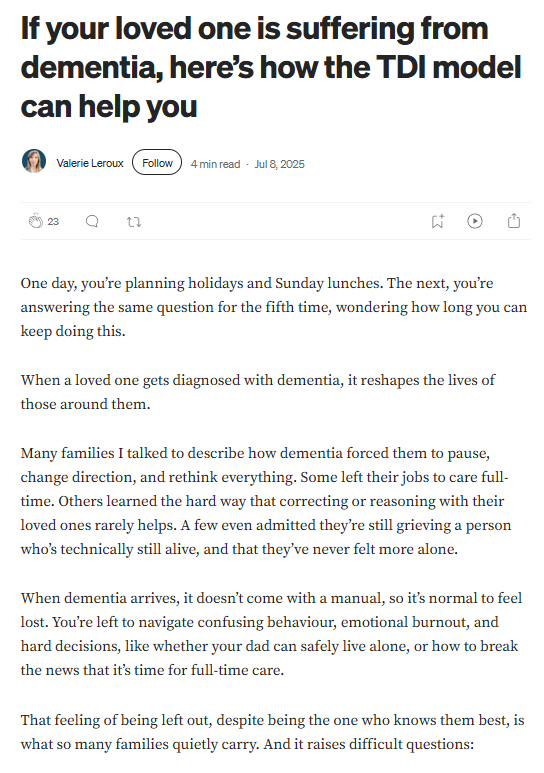
SEO storytelling in action: example from one of my articles on dementia care and the TDI model.
Source: Medium, “How the TDI Model Transforms Family Experiences in Dementia Care.”
Here are some other examples of stories that might be helpful:
one sentence that describes what your reader is going through
a short client scenario shared with care
a pattern you often see in your work
a simple example that makes the topic easier to understand
a founder insight that explains why your approach is different
Val’s tip: If you read this article again more carefully, you’ll start seeing examples of this throughout my writing.
The mistake I see most health businesses make with storytelling
One common mistake is thinking that storytelling means adding a long personal story before the useful information. More often than not, we’re very tempted to give a LOT of background before providing the answer (especially scientists!). The background still has a place, but it becomes more useful once it supports the answer rather than sitting in front of it.
In SEO content, people usually arrive with a question. Your story should help them feel understood and get to the answer with more clarity. It should not make them feel like they’re waiting for a long time to get the answer.
This is even more important in health and wellness content because your reader may already feel tired, worried, confused, or overwhelmed. They need warmth and reassurance, but they also need clear information they can use.
That said, I believe a skilled storyteller can turn a story into an engaging and immersive experience, no matter how long it is. Rather than focusing on the length of your content, what matters more is relevance, meaning that the story should match what the person came to find. If someone is searching for help with sleep, anxiety, gut health, dental care, or menopause symptoms, the story should support that topic.
Here are the main things to avoid:
unrelated background stories,
forgetting to keep the reader at the center and making everything mostly about you (although a story about you can work and help you connect with the audience if you’re part of the target audience and share similar challenges, you should always connect it back to the audience),
using emotion to make a weak claim sound stronger, such as: “After years of feeling dismissed, this supplement finally gave me my life back.” (this suggests a health outcome without enough evidence)
sharing stories that do not match the topic or what people are searching for, such as turning a practical guide into a personal essay (using a short scenario in the introduction could work instead, but the focus would be on providing practical guidance),
or ending the story with a vague next step, such as “Poor sleep can feel exhausting, but with the right support, restful nights are possible.” A clearer next step would be: “Tonight, choose one sleep cue you can repeat, such as dimming the lights 30 minutes before bed or putting your phone outside the bedroom.”
A simple way to sense-check your own content
I know storytelling became a buzz word these days, but no, you do not need to add stories everywhere on your website, only where they’re relevant. Before you publish a blog post, service page, or landing page, here’s a short checklist you can use:
What SEO storytelling will not fix on its own
I look at SEO storytelling as part of a bigger website strategy. It can make your website feel more human, specific, and easier to trust, but your website still needs a clear message, a strong structure, and content that helps the right people find you. I talk more about this in my guide on why a health website may not bring clients.
When to get help with SEO storytelling
You may need SEO support if:
your website looks professional but doesn’t quite sound like you
you are relying on Instagram, LinkedIn, referrals, or word of mouth for most of your visibility, and you’re tired of it
you have blogs, but they are not bringing inquiries
you are not sure what your audience is actually searching for
you do not know what to prioritize on your website
your story is meaningful, but you do not know how to use it on your website
you want your website to explain your value before someone books a call
If this is something you want help with, I can support you in two ways: I offer SEO coaching if you want to make your website more visible and strategic, with simple steps you can implement with my support. I also offer done-for-you SEO website strategy and implementation if you would rather have me putting the work into action.
You can contact me to have an honest chat about what would be most useful for your website and your current business goals 👇
Val ✍🏼
Frequently Asked Questions About SEO Storytelling for Health and Wellness Businesses
-
Storytelling can support SEO when it makes your content more useful, original, and trustworthy. It helps you show real experience, explain your approach, and make your advice easier to understand.
The story still needs to serve what people are looking for (i.e. the human search intent). Start with what the reader came to find, then use stories, examples, or client scenarios to support the answer.
-
Choose the part of your story that helps the reader understand your work. This could be why you started your practice, what shaped your approach, or what you often see with clients or patients.
Keep the reader at the center. Your story should help them think, “This person understands my situation”. You don’t have to go into deeply personal stories if it doesn’t feel safe for you (and that’s okay).
-
Use client stories with care, consent, and clear boundaries. Anonymize details when needed, and avoid sharing anything that could identify someone without permission. You can also use aggregated experience instead of one person’s story. For example: “Many clients come to us after feeling dismissed,” can show empathy and experience while protecting privacy.
I explore this in more detail in my guide to using personal health stories in SEO content.

About the Author
Valérie Leroux, MSc, is a bilingual SEO health writer, strategist, and founder of Bioty Healthcare since 2022, helping health brands and medical writers create high-ranking, trustworthy content backed by science and empathy.

Explore a local SEO case study showing how strategic health content helped an Australian GP practice get more patient inquiries.