
You’ve been working on your SEO for a while. Maybe you’ve been doing it yourself, you’ve taken a course, or you’re paying an SEO provider to do it for you every month.
If you’re a therapist, health coach, health or wellness practitioner, or freelance medical writer, you may have already put a lot of time (or money) into SEO and still be wondering: Is any of this actually working?
One health business owner I spoke to told me she was “just kind of hoping for the best.” Another was getting a weekly SEO report from Ahrefs but said, “I just haven’t been able to action anything.” And I get why.
You might see your traffic increasing without receiving more inquiries. So you’re not sure whether SEO is helping you attract more of the right clients (as it should), or if it’s just a matter of time.
I’ve worked in healthcare marketing for more than 10 years and specialized in health SEO since starting Bioty Healthcare in 2022. I now help health and wellness professionals and medical writers attract more of the right people to their websites, without committing to an SEO retainer.
In this guide, I’ll show you the five simple signs I look for to tell whether SEO is moving in the right direction, what those numbers mean, and when they might be telling you that something needs to change.
What does it actually mean for SEO to be “working”?
SEO is working when the right people are finding you more often, and that visibility starts helping your business.
At first, you may see some positive signals of SEO progress. Google is finding more of your pages, showing them for relevant searches, and giving you more impressions or clicks.
Later, you want to see SEO results. That could mean more inquiries, bookings, sales, newsletter sign-ups, or better-fit clients coming through your website.
For a therapist, that might be more people finding a service page and booking a consultation. For a freelance medical writer, it might be more potential clients landing on your site and reaching out about a project.
There is no single number that tells you whether your SEO is working. The useful question is whether your visibility is growing with the right people and moving you closer to the outcome you actually want.
If you want to see what can happen when that visibility keeps building, you can also look at my local SEO case study showing how a medical practice increased clicks, calls, and bookings.
5 signs your SEO is moving in the right direction
As you may already know, SEO is a long-term game, hence we don’t expect you to get a new client overnight, especially if your website is new. Usually, you see a few smaller signs first. I think of them as clues that Google is starting to understand your website and show it to more people. Here are five signs to look for:
1. Google is showing your website more often
One of the first signs of progress is an increase in impressions. An impression means that one of your pages appeared in Google search results. So if your impressions are growing, Google may be starting to show your website for more searches or more often for the searches you already appear for.
That is an initial positive signal, even if your clicks have not increased yet. You can check your impressions for free in Google Search Console.
Real example: What early SEO momentum looks like
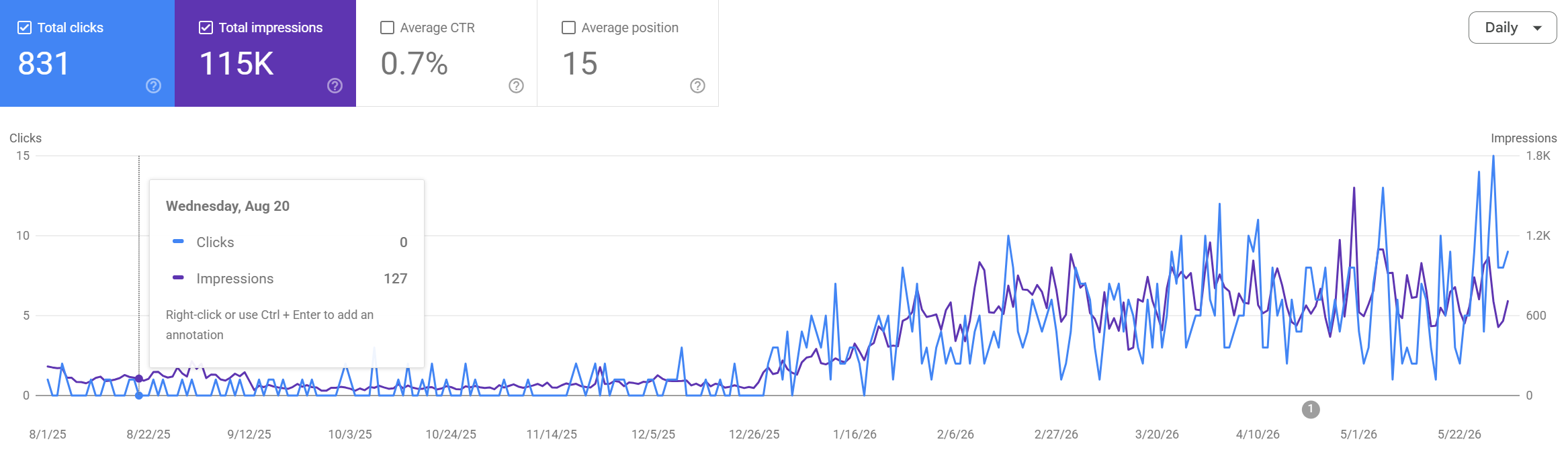
Example of Early SEO Momentum in Google Search Console
Before I started working on my SEO, my website was barely showing up in Google search results. It would only get found by people who saw my name somewhere else. Then, from around January, visibility started to grow much faster. Over this period, Google showed the website in search results around 115,000 times, which led to 831 clicks.
The purple line shows impressions: how often the website appeared in Google. The blue line shows clicks: how often someone actually visited the website from those results.
What matters most here is the direction of travel. Both lines were fairly flat for several months, then started climbing. That suggests Google was beginning to understand the website better and show it for more searches. That’s the kind of early momentum I look for before expecting SEO to generate more consistent inquiries.
2. You are showing up for the right searches
More visibility is only useful if the right people are finding you. For example, a therapist could get lots of traffic from a broad article about anxiety. But if their goal is to attract clients for online anxiety therapy, it matters more that they start appearing for searches linked to that service.
This is why keyword numbers on their own can be misleading. A smaller amount of visibility for a highly relevant search can be much more valuable than thousands of impressions from people who were never likely to become clients.
In Google Search Console, look at the queries bringing up your website: are they the type of queries your potential clients would use?
If you’re a health coach, I go into this in more detail in my guide to SEO for health coaches who want to get found by the right clients.
3. More of the right people are clicking through
Impressions tell you that Google is showing your pages. Clicks tell you that people are actually choosing your result. That matters, but the number of clicks on its own still doesn’t tell you enough.
For a small health and wellness business, 30 clicks from people looking for the exact service you offer can be far more useful than 3,000 clicks from people reading a broad health article.
For example, if you’re a menopause health coach, a few clicks from searches such as “menopause health coach online” may be more valuable than hundreds of clicks to an article about “foods for menopause.”
4. Your priority pages are gaining visibility
It is easy to get excited about total website traffic. Imagine you’re a health coach and one of your articles about “the benefits of drinking water” starts bringing in thousands of visits. That looks great in your analytics. But if those visitors are simply looking for general health information, most of them may never need health coaching.
For a small business, I would pay much more attention to the pages closest to an inquiry. That usually means your homepage, service pages, or important local or service-based searches. These pages are where people are more likely to understand what you offer and decide whether to contact you. For example, if you’re a therapist, I would rather see your anxiety therapy page getting more impressions and clicks than a general blog post bringing in lots of unrelated traffic. This avoids the “I’m getting 8,000 visits per month, but I don’t receive any calls” kind of situation.
5. More of the right people are getting in touch
This is one of the clearest signs that your SEO is helping your business. If more people are finding you through Google and then getting in touch, booking a call, scheduling an appointment, or asking about your services, that matters far more than traffic alone.
For a therapist, this might mean more inquiries from people looking for the kind of support you offer. For a health coach, it could mean more people booking a discovery call after finding your coaching page. For a freelance medical writer, it might mean more project inquiries from companies looking for your type of expertise.
But SEO is only one part of the picture. It can help the right people find you. What happens next also depends on your offer, your pricing, how clearly you explain your services, your reviews, and how easy it is to contact you. So if your visibility is growing but no one is reaching out yet, it may simply mean the next step is to look at what happens after someone lands on your website.
What if your SEO numbers are improving but you're still not getting clients?
I know it can get confusing. You may see more impressions, better rankings, or more clicks and still wonder: “So why am I not getting more clients?” The answer depends on where things are getting stuck.
Your visibility is still low
Google may not be showing your key pages enough yet. That could point to a keyword, page-targeting, content, or technical SEO issue.
Your visibility is growing, but clicks stay low
You may still be ranking too far down Google’s results page. Or your title and description may not be giving people a strong enough reason to click.
Relevant clicks are growing, but no one is getting in touch
At this point, the issue may not be SEO alone. Your service page, offer, pricing, trust signals, or call to action may need work. That’s where I see most of my coachees who tried to do their own SEO struggle.
You are getting inquiries, but from the wrong people
Your keywords or positioning may be attracting people who are not a good fit for your services. This is why looking at the numbers is only the first step. The harder part is working out what those numbers mean for your business and what to change next.
If that sounds familiar, I’ve written a separate guide on why your website is still not bringing you clients, including what to check beyond SEO itself.
How long should you wait before deciding SEO isn't working?
SEO needs a little patience. I was very tempted to check my Search Console every day too! But try not to judge results based on one week, one quiet month, or one keyword moving up or down in Google. Rankings change, and SEO progress is rarely a straight line. As a rough guide:
If your website is new or you’ve only just started SEO, give it around 3–6 months before judging the overall direction. You may see impressions and rankings improve before you see a meaningful increase in clicks or inquiries.
If your website has been around for a while and you’re already actively working on SEO, I’d usually compare at least 2–3 months of data before making bigger decisions about what is or isn’t working.
Research from Ahrefs also puts the typical window for seeing SEO results at around 3–6 months, while stressing that there is no fixed timeframe: it depends! I’ve also seen clients gaining new inquiries in a few weeks when doing SEO strategically. The important thing is to look for steady progress over time, rather than expecting SEO to suddenly “work” after a set number of weeks or months. And if you're seeing no useful progress at all, that's when it may be worth looking more closely at your keywords, pages, or overall SEO strategy.
The simplest way to check your SEO without drowning in data
You could start with a few useful metrics to see if your SEO is moving in the right direction. Start with Google Search Console and check three things:
Compare impressions for your priority pages and searches to see whether your visibility is growing. You can compare the last 3 months with the previous 3 months if you have enough data.
Check clicks to see whether more of the right people are choosing your pages from Google.
Compare that visibility with your business results, such as inquiries, bookings, sales, or another goal that matters to you.
You can use the Queries and Pages reports in Google Search Console to see which searches are bringing up your website and which pages are getting more visibility.
That said, the tricky part is not finding the numbers. It is knowing what they mean for your business and what to work on next. That is where a little strategy can save you a lot of time.
Knowing the numbers is only half the job
Google Search Console can show you what is changing. The useful part is knowing what to do next.
For example:
If your health coaching page is getting more impressions but very few clicks, you may need to improve its ranking or make the search result more appealing.
If your therapy page is getting more clicks but hardly any inquiries, the issue may be the page itself: the offer, trust signals, pricing, or call to action may not be clear enough.
If your medical writing website is getting traffic from broad health topics but not from searches warm leads would use, your keyword strategy may be attracting the wrong audience.
This is where having an SEO coach by your side can help. Instead of guessing, you can use your own data to see where things are getting stuck and decide what is worth fixing first.
I offer a complimentary personalized SEO diagnostic to show you where the strongest search opportunities are for your business, which pages are worth focusing on, and where you may be missing potential clients. You’ll get a clearer view of what people are already searching for, whether your current SEO is targeting the right opportunities, and where your website has the best chance to grow.
Final Thoughts: So, How Do You Know If Your SEO Is Working?
You really do not need to track 20 SEO metrics to know whether things are moving in the right direction. Start with the journey:
→ Is Google showing your important pages more often?
→ Are you appearing for searches your ideal clients actually use?
→ Are more of the right people clicking?
→ Are they landing on the pages linked to the services you want to grow?
→ Are some of those people getting in touch, booking, or taking the next step?
You may not see all of these things happening at once. SEO usually builds little by little. What matters is being able to spot where you are gaining momentum and where things may be getting stuck. And that is often the tricky part. Google Search Console can give you the numbers. But it will not tell you which opportunities matter most for your business or what you should focus on first.
So if you are looking at your SEO and thinking, “Okay… I can see the numbers, but I still have no idea what I’m supposed to do with them,” you are definitely not alone. That is exactly the kind of thing I help with in my SEO coaching. We look at your business, your website, and your own search data together so you can stop guessing and focus on the few things most likely to move you forward.
Frequently Asked Questions: How to know if your SEO is working
-
A good SEO company or consultant should usually start with an audit or review of your website, your current visibility, and what is already working or getting in the way. They should also ask you plenty of questions about your business, your services, your ideal clients, your priorities, and what you actually want SEO to achieve. That gives them a baseline and helps them build a strategic plan around your business, rather than jumping straight into publishing content or changing pages.
That initial discovery, audit, and strategic plan will often be charged as a one-off project or onboarding fee. Some agencies include it in the first month of a retainer instead, so it is worth checking exactly what you are paying for.
Your ongoing retainer should then cover the work needed to put that strategy into action and improve it over time. Depending on your agreement, that could include optimizing important pages, creating or updating content, internal linking, technical fixes, monitoring performance, obtaining links to your website (digital PR), and deciding what to work on next based on the data.
Don’t judge your SEO provider only by how many blog posts they publish or how much your total traffic increases. Look at whether your important pages are gaining visibility for relevant searches, whether more of the right people are clicking through, and whether that is starting to lead to inquiries, bookings, or other business results.
Your SEO provider should also be able to explain what they are working on, why it matters, and what the data is telling you in language you understand.
If you receive reports full of numbers (or no reports at all), but still have no idea whether your SEO is helping your business, it is reasonable to ask more questions.
-
There isn’t one SEO metric that tells you everything. I would look at the journey instead:
Are you appearing for the right searches → are the right people clicking → are they taking the next step on your website?
Impressions and clicks can show that your visibility is improving. But inquiries, bookings, sales, or another business goal tell you whether that visibility is becoming useful.
-
Yes, SEO is useful if your potential clients use Google to look for information, services, or people with your expertise.
And there is now another opportunity: people are also using AI tools to research problems, compare options, and find professionals who may be able to help them. Content that clearly shows what you do, who you help, and why you can be trusted can also increase your chances of being discovered or recommended through AI search.
When SEO is done well, it should help the right people find the pages that matter to your business, whether they discover you through Google or an AI tool.


About the Author
Valérie Leroux, MSc, is a bilingual SEO health writer, strategist, and founder of Bioty Healthcare since 2022, helping health brands and medical writers create high-ranking, trustworthy content backed by science and empathy.

Considering an SEO course for therapists? Compare self-paced courses with SEO coaching and find the right support for your knowledge, website and goals.