
Health SEO and E-E-A-T: How Health & Medical Writers Can Build Credibility Without Being Healthcare Professionals
You may be good at finding trusted health information and explaining it in a clear way. But when you see doctors, nurses and other health professionals writing online, you may start to doubt yourself.
Can people trust your work if you are not a clinician? Will clients see you as an expert? How can you show expertise without pretending to be someone you are not?
I understand this worry because I have faced it too. I do not have clinical credentials, but over time, I learned that I can still build trust by being clear about what I bring to the topic. I have also developed the journalistic skills needed to find strong sources and ask experts the right questions.
In health SEO, E-E-A-T stands for Experience, Expertise, Authoritativeness and Trustworthiness. The term comes from Google’s Search Quality Rater Guidelines and is used to help judge the quality of online content. It is not one single ranking factor, but I found it to be a useful guide for creating reliable content, which is why I’m teaching those guidelines to health and medical writers as an SEO mentor.
In this article, we will focus on expertise. You will see simple examples of how you can show what you know, make your experience clear and build trust without pretending to be a healthcare professional.
TL;DR: Build Credibility Without Clinical Credentials as a Health or Medical Writer
Even if you don’t have clinical credentials, your expertise may come from scientific training, years of health-writing experience, specialist knowledge, lived experience or strong research and reporting skills.
To build trust:
show why your background is relevant to the topic in your biography
use reliable primary sources
quote or consult the right experts when needed
arrange medical review when clinical judgement is needed
stay clear and honest when mentioning your experience
The same person may be highly credible for one topic and less credible for another. What matters is matching the right type of expertise to the article, and as always, trying not to compare yourself to others!
Here’s a 3-minute extract from my 90-minute on-demand workshop, Building Trust and Authority in SEO Health Blog Content with E-E-A-T. In it, I explain how expertise can come from different places and how you can show yours clearly in health content.
Do health writers need clinical credentials to be credible?
You do not need to be a doctor, nurse or other healthcare professional to write credible health content. What matters is that you are clear about the experience you do have, the role you are playing and where your expertise ends.
My own background is a good example. I am not a clinician, but I hold an MSc in biomedical engineering and spent more than ten years working in healthcare marketing before specializing in SEO health writing in 2022.
My role is to research the evidence carefully, translate complex information into language readers can understand and involve a qualified healthcare professional when clinical interpretation is needed.
The same applies to you. Your credibility might come from scientific training, years of health or medical writing, specialist subject knowledge, lived experience, patient advocacy or experience caring for someone with a health condition.
If you are neurodivergent, chances are you will deep dive into a topic of interest (typically, psychology or neuroscience), and you might be able to write a thesis about it pretty quickly, which is another way of developing expertise without having official credentials.
What counts as expertise in health SEO?
Of course, clinical qualifications matter when content requires clinical interpretation or medical recommendations. But your expertise might also come from:
scientific or academic training
years of medical or health-writing experience
specialist knowledge in one area of health
lived experience of a condition
patient advocacy
experience caring for someone with a health condition
interviewing experts and reporting their insights accurately
For example, if you have a science background, you may be skilled at understanding research and spotting where a claim has been oversimplified. If you have written about the same health topic for years, you may have developed strong subject knowledge even without a clinical qualification.
Lived experience can also be highly relevant. A patient or caregiver may be the most credible person to explain what daily life with a condition actually feels like. That kind of insight cannot be replaced by a clinical study, but it should not be presented as clinical evidence either.
You may also bring expertise through your reporting skills. Knowing how to find reliable sources, ask useful questions, interview the right healthcare professionals and translate their insights clearly is a valuable part of health writing.
Credibility depends on the topic
The same person may be highly credible for one article and less credible for another. It all depends on the topic, the audience and the type of information the reader needs.
For example, a patient advocate may be the right person to explain what it is really like to live with a condition. They can share day-to-day challenges, emotional impact and practical insights that a clinical source or a healthcare professional may not capture. Learn more about using personal health stories in SEO responsibly if this is a topic of interest.
A pediatrician, on the other hand, would be a stronger choice for a clinical question about a child’s symptoms, diagnosis or treatment.
How non-clinical writers can demonstrate credibility
You do need to show readers why you are a credible person to write about the topic. Here are five practical ways to do that.
Write a topic-relevant author bio
Your author bio should highlight the experience that is most relevant to the article.
For example, I once worked in sleep diagnostics. I would mention that experience in my bio when writing about sleep, but probably leave it out for an unrelated topic.
In the EEAT workshop, I also use the fictional example of Sophie, a medical writer with a relevant degree, certifications and several years of content-writing experience. Her bio also mentions specialist areas such as gut health, women’s hormones and integrative nutrition. Those details would make her particularly credible when writing about one of those subjects.
I also share the example of Marina, a patient advocate without scientific or clinical credentials. Her lived experience of bipolar disorder could make her a highly credible contributor to an article about what living with the condition feels like.
Neither bio is universally stronger than the other. Their credibility depends on the topic and the type of information the reader needs.
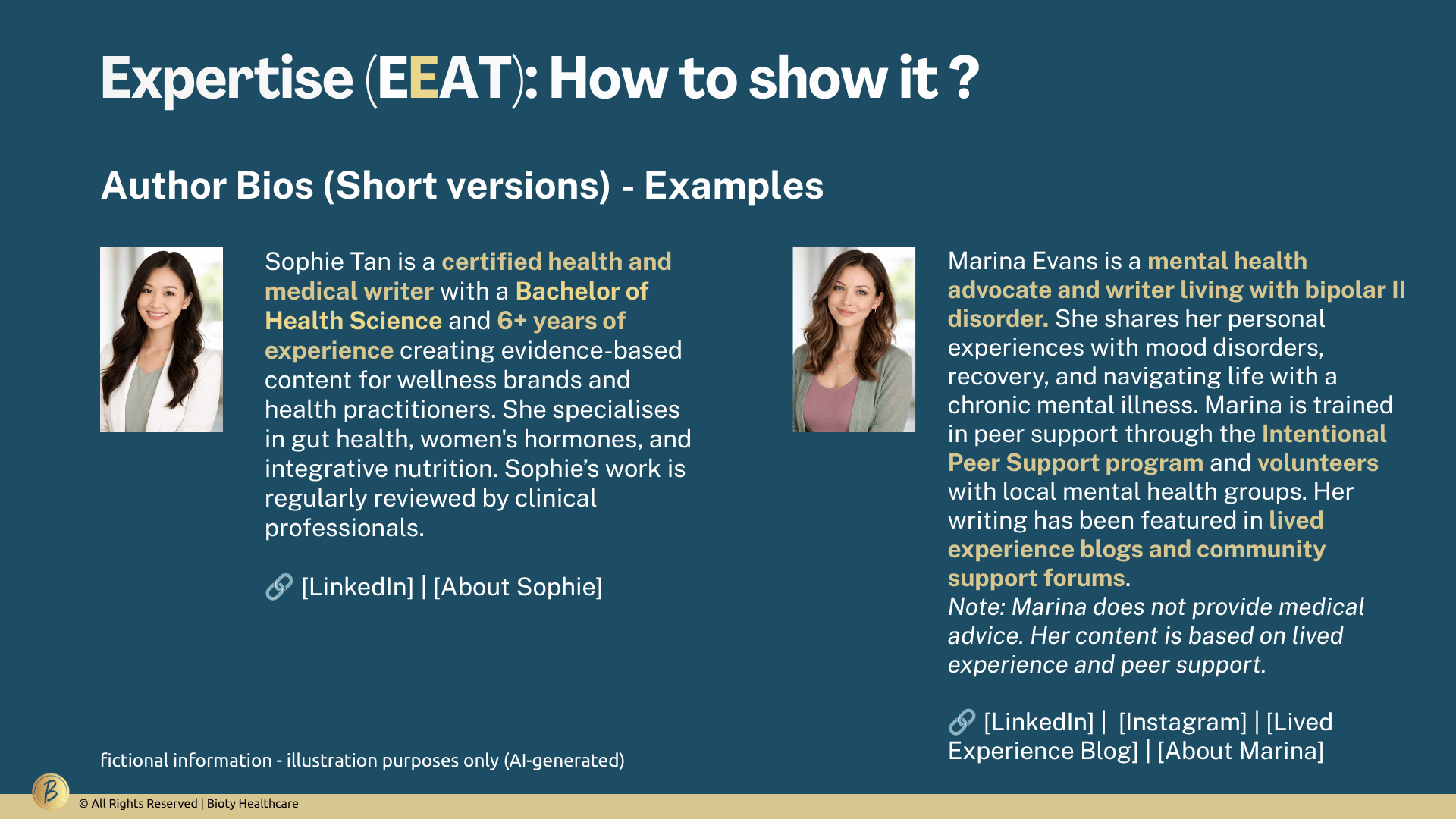
Examples of two health writer bios showing expertise through professional credentials and lived experience. Source: Workshop Building Trust and Authority in SEO Health Blog Content with E-E-A-T (Bioty healthcare, July 2026).
Val’s tips: You do not need to include every detail of your career to your author bio. Focus on the qualifications, experience or personal insight that explains why you are a good fit for that particular article.
2. Use credible primary sources
Whenever you make a health claim, support it with reliable evidence. Where possible, go back to primary sources such as peer-reviewed studies, clinical guidelines, government health websites or recognized professional organizations. Other blogs can help you discover useful research, but they should not automatically become your evidence. I’ve read so many health blogs by now so I can tell you: health bloggers cannot all be trusted even if this is a blog coming from famous websites like the Mayo Clinic or Healthline.
3. Quote or consult the right experts
What I’ve learned over the years is that you do not need to be the expert yourself if you know how to find and report the right expertise. An expert can help you clarify uncertainty, add practical context or explain an issue that the published evidence does not fully answer. Make sure their qualifications are relevant to the specific topic.
Val’s tips: If you simplify or paraphrase an expert’s comments, send the wording back to them before publication. This helps you keep the explanation accessible while making sure it still reflects what they intended to say.
4. Arrange medical review when needed
Not every health article needs medical review, but some topics carry greater risk than others. You may need input from a qualified healthcare professional when the content covers diagnosis, treatment, medicines, safety concerns or complex clinical recommendations. The reviewer should have expertise that matches the subject of the article.
5. Be honest about the expertise you bring
Be clear about your role, what you know and where your expertise ends. Your value may come from research, scientific understanding, specialist writing experience, lived experience or your ability to translate expert insights into clear, useful content. Transparency helps readers understand why they can trust you and when another type of expert needs to be involved.
Val’s tips: Keep a short bio, a full bio and a professional photo ready for clients. You can then tailor the most relevant details to each topic instead of rewriting your profile from scratch every time.
For more practical examples, watch the full E-E-A-T workshop on demand. You will learn how to strengthen your author bio, choose credible sources, use expert insights and build greater trust into every health article you write.
Val ✍🏼
Frequently Asked Questions: Health SEO tips for Health and Medical Writers who are not healthcare professionals
-
Yes, your credibility as an SEO health writer may come from scientific training, years of health-writing experience, specialist knowledge, lived experience, patient advocacy or strong research and reporting skills. The key is to show how your experience relates to the topic and involve a qualified healthcare professional when clinical input is needed.
-
Health and medical writers can build credibility by using reliable primary sources, writing a topic-relevant author bio and explaining complex information clearly. You can also strengthen your content by interviewing suitable experts, arranging medical review where appropriate and being transparent about your role.
-
An author bio should include the qualifications, experience and specialist knowledge that are most relevant to the article. This might include your degree, years of writing experience, previous healthcare roles, certifications, lived experience or areas of specialization. Keep a short bio, a full bio and a professional photo ready so you can tailor them for different topics and clients.
-
Bring in a qualified healthcare professional when the content requires clinical interpretation, medical recommendations or specialist insight. This is especially important for topics involving diagnosis, treatment, medicines, safety concerns or conflicting evidence. Choose someone whose expertise closely matches the subject of the article.



About the Author
Valérie Leroux, MSc, is a bilingual SEO health writer, strategist, and founder of Bioty Healthcare since 2022, helping health brands and medical writers create high-ranking, trustworthy content backed by science and empathy.

Compare the best medical writing courses by career goal (freelancing, SEO, pharma, patient education, CME, or academia) with real-world guidance and honest insights.